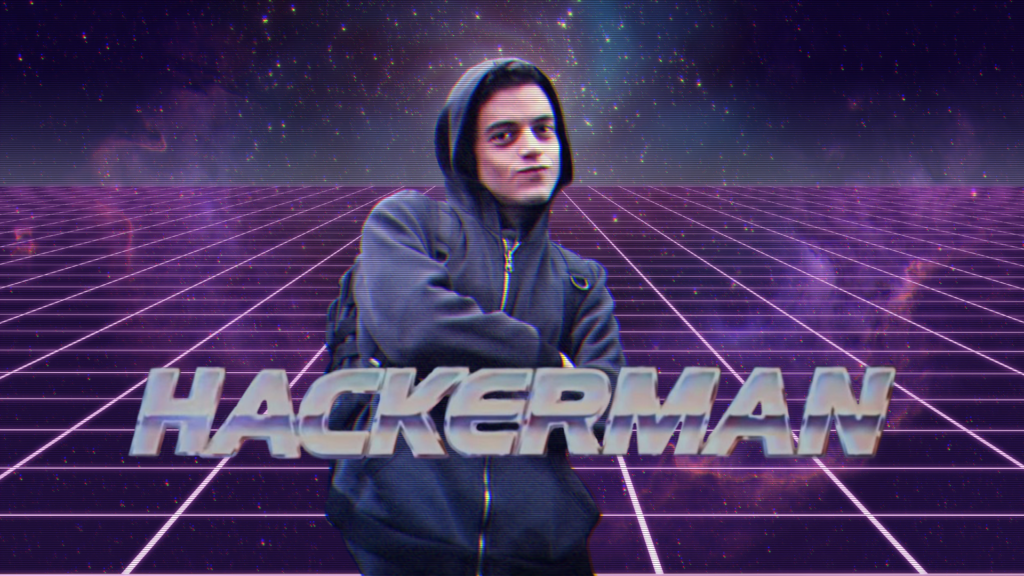
A name from “Kung Fury,” a face from “Mr. Robot”
The image shows Rami Malek in the role of Elliot Alderson from the series “Mr. Robot.” The name HACKERMAN refers to another character: Hackerman from the Swedish short film “Kung Fury,” which David Sandberg released in 2015. The film parodies eighties action and science fiction: its world is built from acid neon, deliberate pathos, absurd twists and computer effects that seem to promise the impossible. Hackerman fits the same logic: he is not simply a person at a keyboard but a fantastically powerful specialist for whom technology obeys the laws of adventure.
How the caption moved to other faces
In August 2015 a separate edit appeared in the “Mr. Robot” fan community: a photo of Rami Malek as Elliot Alderson was combined with the same word, HACKERMAN. This early version fixed a recognizable formula: an unfamiliar frame, a large caption and a joke about an inflated estimate of technical skill. Later the word became an almost independent line that could be placed next to any character in a focused or important pose. This picture uses the same idea of an edit with Elliot: the grid and the caption give the photo the atmosphere of fantastic computer omnipotence.
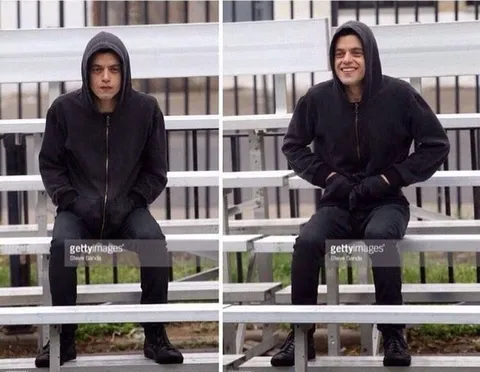
The two images have different tones. The shot of Elliot usually recalls the series’ serious drama and its story about hackers; the hyperstylized Hackerman is much closer to a parodic adventure. When the caption is moved between them, it keeps its general meaning, but the degree of pathos changes: one version reads as a serious statement, the other as a deliberate fantasy of computer omnipotence. In later variations the word sometimes appears even without any direct link to programming; it simply turns an ordinary success into an episode of a big action movie.
Why a small win becomes a feat
The meme inflates the hero’s self-esteem to the size of a fantastic plot. A person solved a problem and already seems to have hacked a secret base, though he may have only restarted the router or remembered a password. The picture supports this hyperbole: the crossed arms look like a poster pose, the purple perspective stretches toward infinity, and the huge caption leaves no doubt about who is in charge here. What is funny is not that the character actually can program, but the mismatch between the solemn status and a simple action.
There is a second layer: the film itself already jokes about how cinema depicts computer work. Instead of a quiet search through documents, an almost magical action is imagined here, which needs only a dramatic name and a confident pose. The meme keeps this exaggeration but carries it into real everyday life: it helps people laugh at how quickly an ordinary action gets turned into a sign of exceptional talent. That is why the caption fits not only programmers. It can be attached to any episode where a person awards himself a medal for getting a task done without an audience or special effects.
Invented captions
Imagine a person connected a printer without help from colleagues and announces: “Restored the link between worlds.” Another example: after a spreadsheet stopped showing #### instead of a sum, an employee sends this frame with the caption “Financial system saved.” Or a student found night mode in phone settings and writes as if he had optimized the campus’s digital infrastructure. In all three cases a minor skill is presented as legendary, and the image adds synthesizer-style grandeur to it.