What's shown
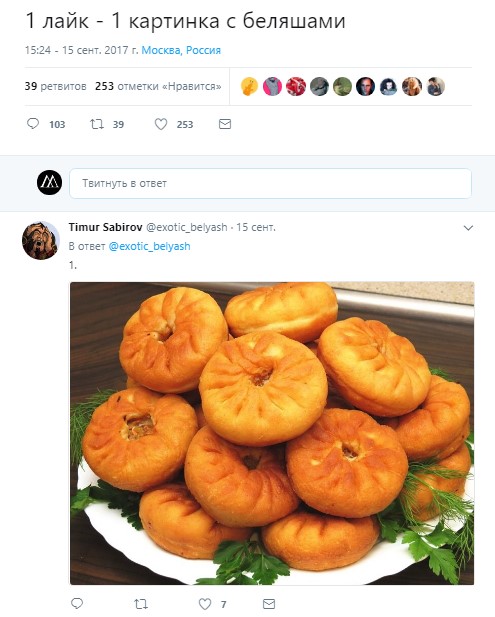
The screenshot shows a tweet from September 15, 2017, with the heading "1 like - 1 picture with belyashi." It's a parody of the flashmob format: instead of the promised facts, the author offers a picture. Below the post is a reply numbered one, with a photo of a dish of fried belyashi — golden-brown pies with a juicy filling, piled on a white plate and garnished with herbs. At the time of the screenshot, the post had 253 likes and 39 retweets.
Visually, the screenshot reproduces the Twitter interface of the time: avatar, name, publication time, and reply and like counters. It's precisely this familiarity that makes the joke instantly clear. The reader recognizes the familiar format and immediately understands that food is being offered instead of information.
Origin of the format
The exact date of the first thread in the "1 like = 1 fact" format has not been established. The format developed on the Russian-speaking Twitter in 2017: authors published a series of tweets in which each point was a separate fact, and readers gave likes. According to journalists' observations, in the weeks before the noticeable wave of posts, such threads appeared every day. The topics varied widely: travel, work, education, difficult life situations, films, and even professional experience.
The format relied on a long-standing habit of social networks: promising an action in exchange for engagement. Likes became a currency of attention, and the promise "I'll tell as many as I get" turned a simple activity into a small performance. The author acted as a storyteller, and the audience as a client, and this asymmetry quickly became the target of jokes.
Irony and parodies
Within a few weeks, users started mocking the format itself. Journalists noted that the "1 like — 1 fact" thread showed up in almost every feed, and that many authors didn't know what to say. One headline on the subject read: "Secondary education, read just nine threads," meaning the joke was that reading a few such compilations could substitute for an education.
Parodists came up with their own versions: "1 like — 1 fact about working in an office," "1 like — 1 fact about my fridge." The point of these jokes was that the format allows any subject and any level of usefulness, which makes it easy to push to absurdity.
Belyashi and the mechanics of the joke
The belyashi parody works on the classic principle of substituting expectations. The reader expects facts, since the heading sets up a certain genre, but gets a picture of food instead. Russian-speaking internet users are well acquainted with belyashi as everyday food, so the parody sounds both absurd and familiar. The number "1." under the heading underscores the seriality of the format and parodies its structure.
The mechanism resembles many other substitution memes: the form stays the same, but the content changes to something unexpected. That's exactly why the "1 like = 1 fact" format spawned a great many imitations, and its parody became a genre of its own. The joke rests on the shared experience of social-media users who have seen hundreds of identical threads and had no objection to seeing them mocked.