A reply to a comment
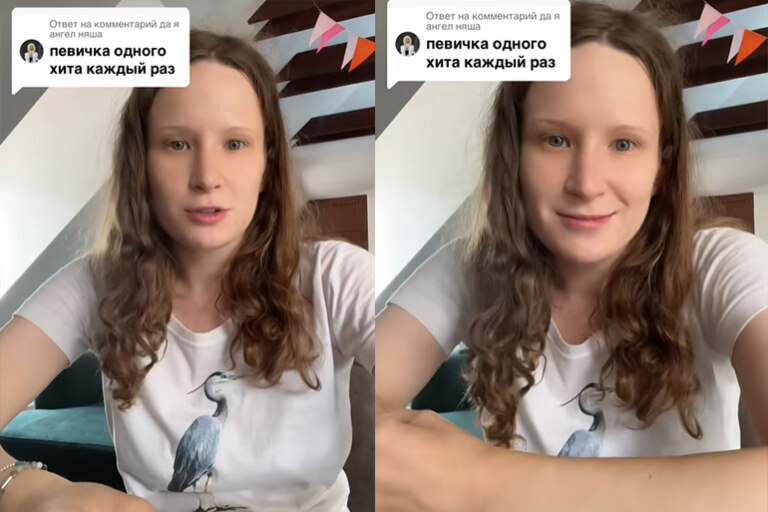
The phrase is linked to a short video by the singer Monetochka (Elizaveta Gyrdymova), published in 2023. She was responding to the accusation that she supposedly has only one well-known hit. The reply sounds like a counter-question: if I have one, how many do you have, two? The clip quickly spread separately from the original comment, and the words became a standalone audio reaction and caption.
The context matters: this is not about counting songs or a serious conversation about a music career. The joke exposes the weakness of the yardstick the other person uses to devalue someone's achievement. Instead of a long argument, the reply hands the comparison back to whoever started it. The listener recognizes the tone: bewilderment mixed with challenge, as if the other person had proposed some obviously meaningless arithmetic. Later images use the line more broadly, without necessarily referring to the singer herself.
Why a short question became a meme
The phrase has a compact form and a clear turn. The first half sounds like a question about quantity, and the second is a mocking guess of a number so small that it can't support the accusation. It is not proof that you are right but a way to show how petty the original jab sounds. In a short video, the pause and delivery matter too: calm bewilderment sometimes works stronger than shouting because the reply doesn't take the attack seriously.
For example, someone says: "You have only two decent photos from the trip?" — "And you have, what, one?" Or a colleague says he managed to help the project only once in a month; the reply can play on his overly strict scale. In a modern version, it helps to keep exactly the absurdity of the comparison rather than use the question as an automatic insult. If the other person is actually discussing statistics or wants to help, a meme reply may only make the conversation tenser.
How the intonation works
The line is funny when it is delivered as if the critic had accidentally made himself look bad. The question "how many do you have?" doesn't ask for a detailed answer: it exposes a competition nobody agreed to hold. That's why you can move the phrase to everyday topics—how many books you've read, successful attempts, free days off. But without the original occasion it can lose its aim: the reader must see which claim is the target.
In a visual editor, a large, short line of text and a simple image of the speaker work well. A long explanation weakens the pause, and several competing captions make readers hunt for what exactly they are supposed to compare. If you use sound, the phrase's rhythm is key, not an exact imitation of Monetochka's voice. More important, do not attribute invented words to her: new captions are users' variations, not a continuation of the original video.
Where this reply is appropriate
The meme works best in friendly banter where both sides understand they are arguing about a trifle. It helps turn an absurd comparison into self-irony: "My plan for the evening is to watch one episode." "And you have, what, two evenings?" You can build variations without numbers if you keep the form of a counter-question: for example, on an unexpected audit of someone else's standards. Don't turn it into an all-purpose reply to any remark: a meme does not resolve a real complaint.
If you need a softer tone, the caption should make clear that it is about one specific joke, not about the person's worth. In the original context the intonation is sharp because the line answers criticism of public success. In a personal chat, the same phrase can sound insulting. So consider how familiar the audience is with the source and whether the context is visible. A strong version stays short, responds precisely to the absurd yardstick, and lets the conversation end with a smile rather than another round of arguing.