What is in the picture
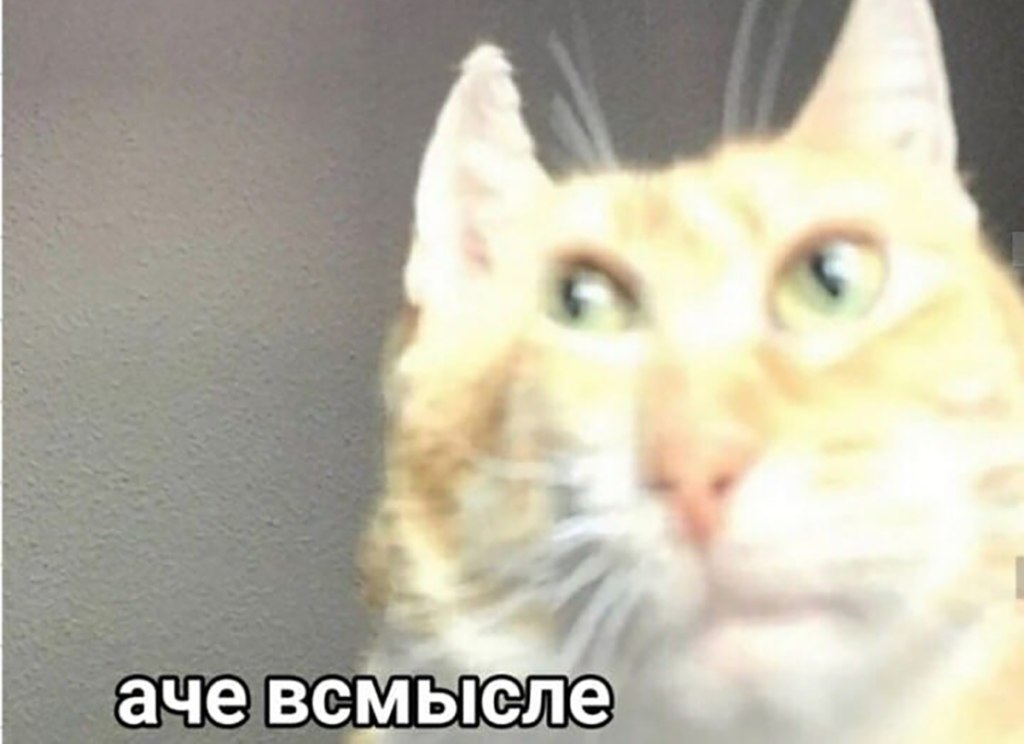
The shot is taken very close and out of focus: almost the entire frame is the face of a ginger cat with white whiskers, a pink nose and pale eyes. Neither the face nor the background is sharp, so the image looks like a random phone snapshot taken at the moment the animal suddenly moved toward the lens. The background is a plain gray wall. The pupils look sideways and upward rather than straight into the camera, which makes the gaze look bewildered and slightly suspicious.
At the bottom, in white letters with a black outline, is the phrase "ache vsmysle." It is a colloquial spelling of the question "a chyo v smysle?" ("wait, what do you mean?"): the words run together and a letter is lost, as in fast chat messages. This spelling sets the tone at once: the one asking is not a polite interlocutor but someone who has just heard something unbelievable and is hurrying to object.
What is known about the origin
Nothing is confirmed about who made this picture or when: there's no record of the cat's owner, the first post, or whether the caption was added by the photographer or picked up later, and no date or platform can be pinned to it. It survives as an anonymous reaction image on the Russian-speaking internet, passed from chat to chat with no credited source.
That's typical of reaction images like this one: the blurred, sideways-looking gaze described above outlasts its original context, and it's that expression—not the photo's backstory—that gets copied into new conversations, doing much the same job as an emoji, only more expressively.
How the emotion reads
The phrase "a chyo v smysle" almost never works in live speech as a genuine clarifying question. It is an exclamation of bewilderment with a note of complaint: the person does not directly deny what was said, but shows that it does not fit in their head. The cat with the bewildered gaze conveys exactly that combination. It is not angry, and it is not laughing; it has frozen.
The blur works in the joke's favor. A sharp portrait would read as staged, while a smeared shot looks sincere and a little awkward, as if the cat is actually trying to understand what it has just been told. The comic effect also comes from the contrast between the everyday seriousness of the caption and the soft, fluffy face.
Caption examples
Captions for this template are usually built on a "statement and reaction" pattern. Here are a few invented variants.
"Boss: 'The deadline got moved up to today, but you'll still make it.'" The sharp shift in expectations works here: the message is presented as a trifle, and the cat shows that it is no trifle.
"Friend: 'I've never seen a single Nolan film and I'm not planning to.'" The reaction comes to a harmless but unexpected confession, and the joke builds on exaggerated outrage.
"Schedule: three classes in a row in different buildings, with a five-minute break." The cat seems to be asking reality itself, not any particular person.
"Grandma: 'Borscht without beets is still borscht.'" An everyday argument in which one side flatly disagrees is the most fertile ground for this picture.
How to use the template
The cat works best without extra explanation: it is enough to send the picture in reply to someone's remark, and the meaning will be clear. If you want a captioned meme, keep the short line the cat is reacting to, and do not spell out the reaction in words, because the face already says everything.
Avoid situations where bewilderment is out of place: when someone shares grief or describes a serious problem, a reaction of surprise sounds tactless. But in chats with friends, in comments on absurd news, and in discussing awkward situations, the cat remains a handy way to say "well, that's a bit much" without harshness.