A cat in the snow
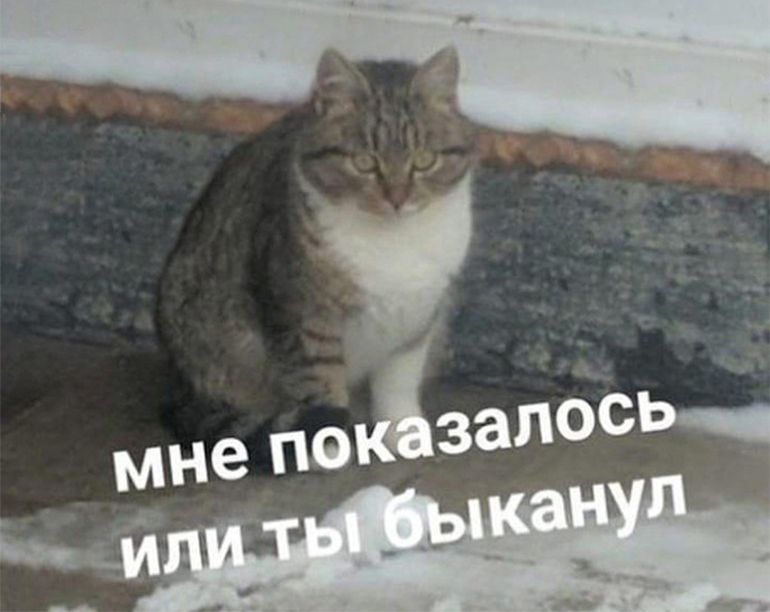
The photo shows a striped cat, gray-brown with a white chest, sitting on a snowy surface against a gray wall with an orange stripe along its top edge. Its gaze is direct, its eyes slightly narrowed, its ears up, and its face looks composed. The pose is relaxed, but the expression is stern, almost like someone listening to a wrong answer.
The caption is in bold white type across two lines at the bottom of the frame: “was it me / or did you just talk back,” with no punctuation and in lowercase, the way photos are usually captioned in a phone editor. There are no other animals or people in the frame.
What “Bykanut” Means
“Bykanut” is a colloquial verb that usually means to act defiantly, to push back, or to snap back at someone's remark. It is an informal word with a hint of everyday exaggeration: it refers to a minor act of sass, not a serious conflict.
The question “was it me, or…” softens the phrase. The speaker doesn't accuse outright but checks whether they understood the situation correctly. The mix of polite doubt and a jab creates a comic effect, especially next to a face that looks very self-assured.
What is unknown about the photo
The photographer, the location, the date of first publication, and the person who first added the caption are all unknown. The cat's name and the history of its owners are also not established, and it would be wrong to attribute them to the picture. All that is known is what can be seen: a house or street cat was photographed in the snow, and text was added afterward.
Like many Russian-language cat pictures, this photo lives as a ready-made template: it is captioned in various ways, while the original text remains recognizable. Until evidence to the contrary appears, the origin should be treated as an open question.
Caption examples
Below are three captions in the same construction. Each takes a neutral object and gives it audacity.
“Was it me, or did the kettle boil on purpose just to spite me?” A household appliance seems stubborn, and the cat's stare confirms it.
“Was it me, or did the alarm clock go off louder than usual today?” The morning turns into a conflict, and the cat acts as judge.
“Was it me, or did the Wi-Fi decide to drop out right now?” The internet becomes the one behaving defiantly, and the question sounds like a complaint. All three work the same way: a small object, polite doubt, and a serious face.
How to use the template
The format suits small everyday provocations: a cat on the doorstep, a line at the store, a broken elevator. The smaller the scale, the better the caption works. Don't use this construction against specific people: a light phrase then becomes a jab that is hard to aim without causing offense.
In conversation, it's appropriate to keep the playful tone and not add anyone's appearance or personal details. The cat looks very serious, and the joke rests on that seriousness, so it's best to cut extra words.
A good way to test a caption is to read it aloud and imagine the cat answering. If the answer is funny without any explanation, the formula works. If you have to explain what you meant, pick a simpler object and shorten the doubt. A caption that rests on one object and one look almost always reads faster and earns more smiles than a long text with several digressions.