What is visible in the photo
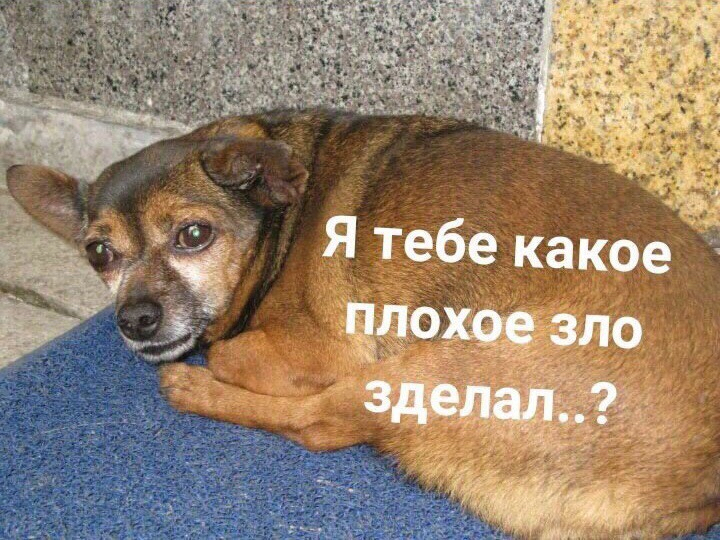
The dog lies on its side, paws tucked under, with its muzzle resting on a blue fuzzy rug. The fur is reddish-brown, darker on the face, and gray shows around the eyes and on the nose. One ear stands up and tilts slightly to the side, the other is folded and pressed flat. Dark eyes look straight into the lens, the head is slightly lowered, so the gaze comes out from under the brows.
Behind the dog is stone cladding: gray granite on the left, light stone with yellow flecks on the right. The setting is everyday, with no sign of staging or special lighting, and this matters for the joke: the frame looks accidental, so the resentment in it seems real.
The text on the image
Large white letters sit right on the dog’s side and take up three lines: “What bad evil / did I do / to you..?” In the title of the article the word is spelled correctly, as “sdelal,” while on the picture itself it begins with a “z” instead — “zdelal.” Rough spots like this are typical of homemade captions and do not get in the way of the meaning.
The phrase is built as a conversational complaint: “what bad evil” sounds slightly absurd, because evil is bad by definition. This light redundancy makes the reproach sound childishly sincere and adds comedy. The question mark preceded by two dots conveys the pause before the wounded creature breathes out the question.
What is known about its history
The author of the photo, the date it was taken, and the first publication with this caption have not been established. Collections of dog memes often overlap in theme, but they refer to other pictures, so their history cannot be transferred to this image.
The emotion the viewer sees on the dog’s face is a reading of the frame, not a proven state of the animal. The dog could simply be tired or lying in a relaxed pose, and the caption is what gave it the resentment. This gap between an innocent picture and a dramatic line is exactly what the joke rests on.
Why the reproach from the dog’s point of view works
Dogs make convenient “talking” characters in memes: their expressions allow any interpretation. Drooping ears, a furrowed brow, and a gaze from below are things viewers are used to reading as guilt or hurt, so the line lands on a ready-made expectation.
The second mechanism is role reversal. Usually the dog is the one who looks guilty, but here it is the one making accusations against its owner. The question “what bad evil did I do to you” asks for an explanation, and the reader unwittingly tries on the role of the culprit: remembers not letting the dog on the bed, taking away a bone, or leaving without a walk.
Examples of captions
“You promised a walk, and then you left for work.” The caption leans on the image of an abandoned pet, and the look in the photo backs up the accusation. The contrast between the complaint and the calm pose is what makes it work.
“I just asked why the bowl is empty.” The question sounds innocent, but the dog lies as if the verdict has already been handed down. It is funny that a household trifle gets raised to the level of a family tragedy.
“They told me it was the last piece.” The caption turns a small matter into a tragedy, and the photo becomes evidence of the resentment. A short phrase works better here than a long story.
“They said ‘one minute,’ and that was the second minute.” The joke is built on counting time: the viewer sees for themselves how long the wait has dragged on, while the dog takes the pose of a patient sufferer.
How to write your own caption
The formula is simple: a question or complaint in the first person, a neutral tone, and a specific trifle. The smaller the cause, the stronger the resentment and the funnier the contrast. A long text ruins the effect: the caption should read in one breath, like a line spoken from a corner of the room.
The picture works best for stories about small everyday injustices: food, walks, a light switched off, a closed door. The joke stays harmless as long as the voice belongs to the dog, not to a specific person, so do not tie the caption to someone’s appearance or personal circumstances.