What's in the picture
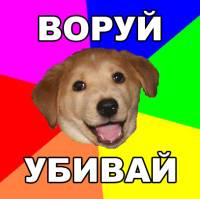
The picture shows the head of a golden-colored dog with its mouth slightly open and tongue out. Its gaze is aimed straight at the viewer, and the muzzle's expression seems both friendly and conspiratorial at once. The head is cut out against a background of colored segments resembling a rainbow, which makes the template easy to recognize even at thumbnail size.
The text is placed in two large white letters with a dark outline: "STEAL" on top and "KILL" on the bottom. This layout matches the advice-animal format: the top sets up a situation or question, the bottom gives the advice. Here the advice looks absurd, because it comes from a friendly-looking dog and bluntly calls for a crime.
The contrast between the cute face and the brutal advice is the basis of the joke. The picture works like a greeting card turned inside out: the image of a caring friend is combined with an immoral recommendation.
Origin
The basis for the meme is the foreign "Advice Dog" template, which the English-language internet used for short pieces of advice presented as captions. The Russian version appeared around 2008 thanks to the imageboard Upyachka, where the first captions in the advice-animal format were created based on the foreign template. That same year an internet radio station of the same name appeared on Upyachka, and the phrase became established as one of the first Russian-language captions of this kind.
A notable push toward its spread came when the phrase appeared in the trailer for the American game Alpha Protocol in 2009: one frame featured a sign with these words. The authors of one account believe the developers may have picked it up from an image search, so the exact path the phrase took into the game is hard to establish. Either way, in the Russian-speaking space this detail became an occasion to discuss the meme all over again.
Over time the phrase became something close to a folk saying. The band Alai Oli released a song called "Voruy-ubivay reggi," and the meme itself spawned variants with continuations, for example about geese. In this way the template grew from a simple caption into a self-contained piece of folklore.
How the meme is used
A typical caption keeps the two-part structure: a short phrase on top and an equally short phrase on the bottom. The more absurd the advice, the stronger the effect, so variants are often built on a sharp shift in tone between a serious exhortation and an everyday situation.
The meme was often used in comments as an ironic summary of someone else's action or situation. The advice sounds serious but reads as a parody, which is why the template suits discussions where someone proposes an obviously unacceptable solution.
The template also turned out to be convenient for reacting to news and for responses in arguments: just change the text, and the picture already sets the right tone. That's exactly why the meme went through different waves of popularity.
Why the meme works
The mechanism is simple: a trusting tone from the advisor combined with blunt, absurd advice. The dog's face looks caring, which heightens the effect when the advice sounds like a recipe for a crime. The more serious the delivery, the funnier the result.
The format is short, recognizable, and easy to reproduce. Creating a new caption requires no drawing skill: just text and the familiar template, which is why the meme kept growing with many variants.
Finally, the phrase itself slots easily into spoken language. Two short verbs sound rhythmic and memorable, and playing with morality makes them universal for all sorts of situations.
Legacy
Today "Voruy-ubivay" is seen as one of the recognizable early Russian advice animals. It has become part of the internet's homegrown folklore and is often recalled as an example of how a foreign template took on a life of its own on the Russian internet.
The phrase's origin isn't fully verified in detail: the author of the first Russian caption hasn't been established, and the accounts of its appearance on Upyachka and in the game rely on recollections and image searches. This is typical of many early internet memes, which lived in anonymous communities.