Who sits and who strikes
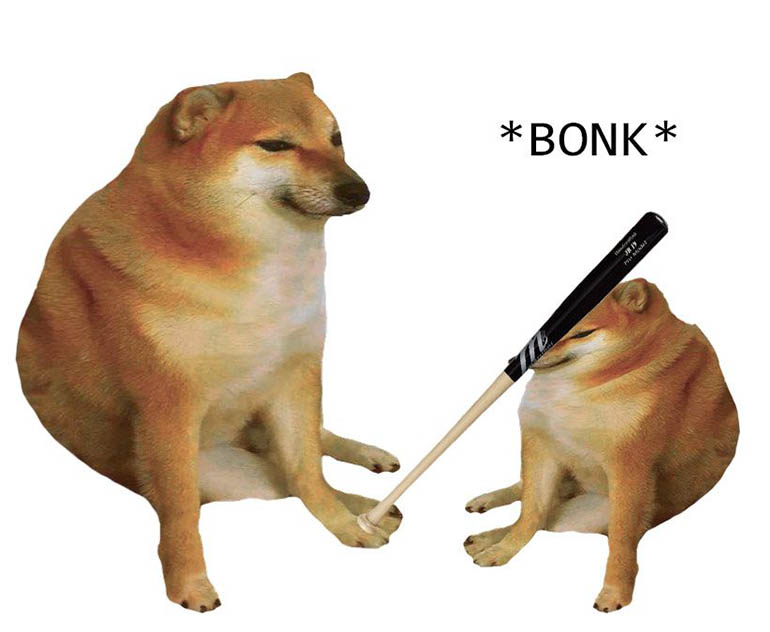
On a white background are two ginger Shiba Inus. On the left is the large one, with a powerful chest and a restrained expression: it sits sideways and looks down at the smaller dog. On the right is the smaller one: its head is pressed from above by a black bat with a white handle, and its eyes are closed. The bat rests on the big dog's paw, as if it were the one swinging it. Above the smaller dog, in asterisks, is the word “*BONK*”, a sound effect for a hit.
The picture is assembled from cut-out images and is clear without text: the strong punishes the weak for something. The cheerful tone comes precisely from the combination of sternness and the soft, comic look of the dogs.
The story of the two dogs
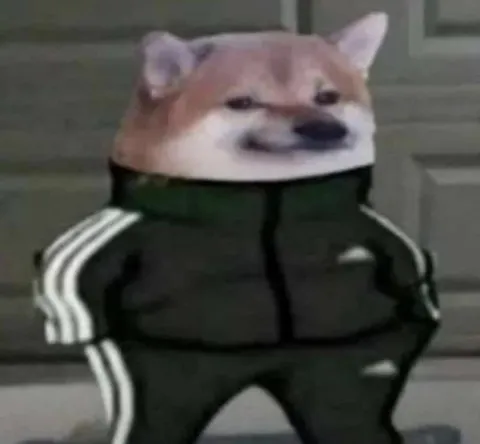
The smaller dog is the famous Shiba Inu named Balltze, known online as Cheems: he is the one who takes the blow in this format. The large dog is a variant of the “doge” image, which in memes stands for strength and power; next to him, Cheems stands for weakness and regret. This pair often appears in memes. Balltze died in August 2023, and many users remembered the dog through exactly these templates.
The “bonk” line itself, according to descriptions, goes back to a video published on Instagram on 13 July 2019, in which a dog was “bonked” with a hammer to a comedic sound. In the following days the clip spread through YouTube compilations, Twitter and Reddit, and later versions with other objects and characters appeared. The picture with Cheems and a bat became a standalone template later.
“Bonk” as a sentence
The main meaning of the meme is playful punishment. The caption “Go to horny jail” (roughly “go to jail for being horny”) reportedly appeared in March 2020 and by April had taken hold on Twitter as a reaction to suggestive and indecent jokes. The one swinging acts as a “decency moderator”: no arguments are needed, only the sound.
Like many “law enforcers” in memes, he does not act seriously. It is a ritual: the conversation partner admits their own slip and laughs at it. That is why “bonk” is most often sent to friends rather than to enemies.
Invented captions
“Me: I have no plans tonight. Fridge: *bonk*.” The caption turns the blow into the voice of conscience.
“I was going to add one more show to my watch list. *BONK*.” The one swinging stops the endless accumulation.
“When someone in the chat writes ‘you know what I mean’. *BONK*.” The meme puts an end to hints.
“My hand reaching for a fourth cookie.” Here the big dog is self-control, and the small one is the body.
Why the image caught on
The simple composition reads instantly: two figures, one gesture, one word. The picture does not require knowing other memes, although the dog pair has been known for a long time. A participant can easily swap in their own roles: who strikes, whom, and for what.
Besides, the template is safe in tone: the blow is conventional, with no sound of pain, and the dog can be replaced by any other character. It is exactly this softness that has let it outlive many other “punishment” jokes.
Tips for use
Use the template for light teasing: a risqué joke, an overly bold purchase, an extra helping of dessert. It is not suitable for serious arguments: the aggression in it is read as playful, and on a heavy topic it can look like mockery.
If you caption the image, add the reason in a sentence or two: “bonk” works best when the viewer immediately understands what the punishment is for.