What's shown
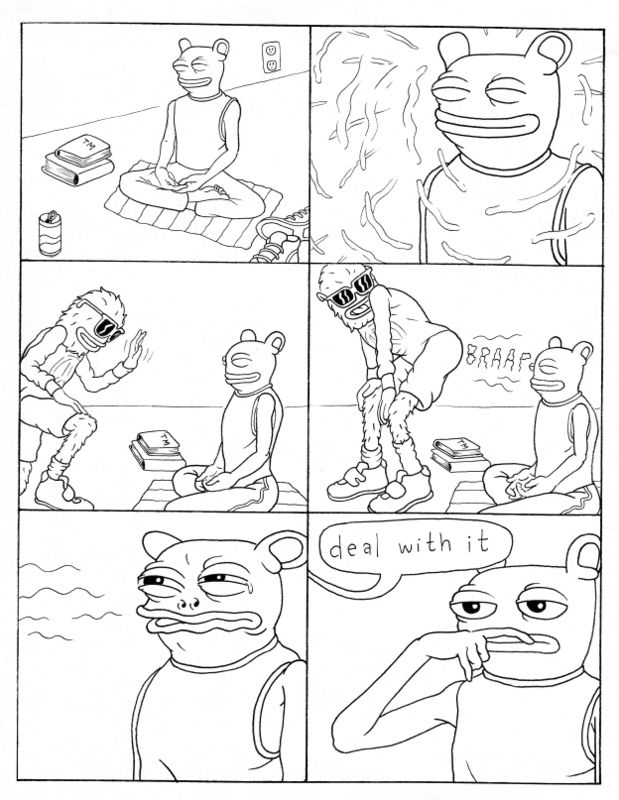
The picture is a six-panel comic in black-and-white art with thin outlines. First it shows a character in a tank top sitting cross-legged on a mat. Then another character in sunglasses appears in the frame, with "BRAAP" written next to him, and he leans forward, showing disregard for those around him.
The final panels set the meaning. The character, with half-closed eyes and a smug expression, rests his chin on his hand, and a speech bubble reading "deal with it" appears above him. It's exactly this line that turns the comic into a rebuff: the character doesn't argue, he shows that he doesn't care.
The sunglasses here serve as a sign of confident disregard. Later they became a standalone symbol of the meme on their own, and even without the comic, a picture with sunglasses was understood as "well, too bad, deal with it."
Origin of the phrase
The exact origin of the phrase itself hasn't been established. It was a common colloquial expression that, on English-language forums, meant roughly "get over it." In 2005, Matt Furie, the creator of the Pepe character, posted a web comic with this phrase on MySpace, but whether it predates him is hard to say.
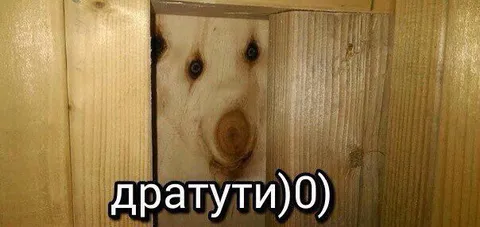
On the forum SomethingAwful the phrase was a frequent cliché, and the GIF with the smug dog, according to available information, originated there as well, though the exact date is unknown. In December 2008, a picture with Pac-Man appeared on the site Bibanon captioned "I'm Atheist / deal with it," which was later cited as one of the meme's sources.
The phrase was also heard in public speech. In February 2011, Wisconsin basketball coach Bo Ryan said after a win, "we won the game. Deal with it," and that remark quickly spread across the web. It showed how a blunt rebuff turns into a universal formula for smug triumph.
The sunglasses and the 2010 GIFs
The meme's main visual mark came about thanks to a photoshop. Ryder Ripps, who worked on the site dump.fm, made versions of the SomethingAwful dog image with sunglasses and released the template into the public domain. That's how the sunglasses became attached to the picture, and the idea itself started being transferred onto other faces and figures.
In June 2010, dump.fm held a contest for GIFs with falling sunglasses, and the format's popularity shot up sharply. On June 4 of that year the site's administrator posted a GIF on Tumblr, and on July 25 an article came out in Urlesque and the site DealWithIt.net appeared. Soon after, photographer Chris Clanton posted real photos with falling sunglasses, which finally carried the meme over from the digital realm into reality.
The catalog dates the meme to 2009. That year can be considered a nominal starting point for the picture's popularity, though the mass spread of sunglasses with a falling effect happened in 2010.
Spread online
In October 2010, the first definition of the phrase was submitted to the SAClopedia dictionary, and in 2011 the expression became noticeable on Twitter. On March 7, 2011, the hashtag #DealWithIt trended after students at Ohio State University displayed 1,400 towels reading "DEAL WITH IT."
The meme then moved into image macros and GIFs, where the sunglasses fell onto the faces of celebrities, TV characters, video game characters, and ordinary users. Such reworkings quickly spread beyond the English-speaking segment.
In the Russian-speaking space, two meanings became fixed at once. The first is the picture with sunglasses as a visual sign of a smug response. The second is the phrase itself, used as a short rebuff like "get over it" or "deal with it yourself."
Why it works
The meme's main strength is its brevity. One phrase and one picture let you end an argument with a winner's playful gesture. The sunglasses work as a visual signal: the wearer shows that there will be no continuing the conversation.
The irony here is double: the rebuff is delivered as a proud, almost comical gesture, so it's perceived more as a joke than as an insult. This makes the meme convenient for friendly chats and ironic comments.
Another reason for its durability is how easy it is to rework. The sunglasses can be added to any portrait, and the meaning will hold. Thanks to this, Deal with it outlived the era of early internet GIFs and remains understandable even to those who don't know the history of how it came about.