What the image shows
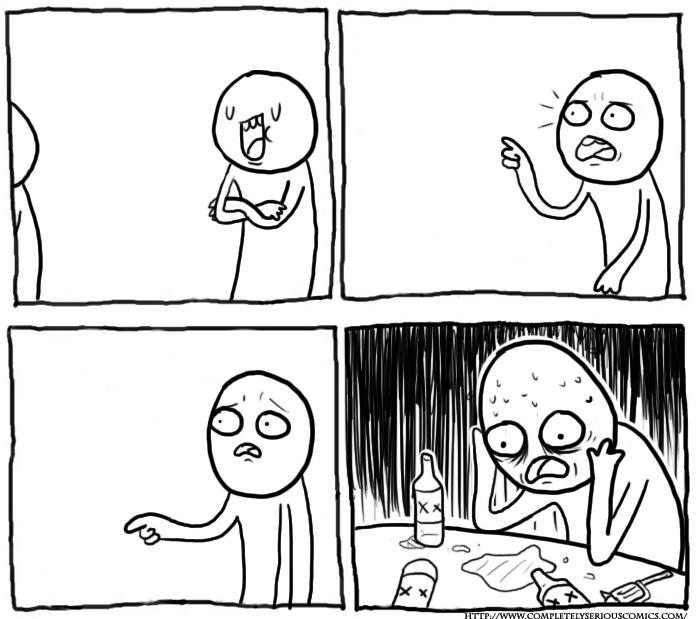
The comic consists of four panels drawn in simple lines. In the first panel, a character with an open mouth and crossed arms is passionately arguing something. In the second he's pointing a finger, as if accusing or singling someone out, his face looking tense. In the third his expression turns confused, and the finger is now pointed off to the side. In the fourth he sits at a table with bottles on it, head in his hands, with an expression of complete despair.
The background in most panels is white, and the character is faceless — a round head on a thin body. Dense hatching behind him in the final panel conveys a heavy mood and sharply separates the ending from the calm beginning. In the corner of the last panel is a caption with the name of the webcomic Completely Serious Comics, on which the series was originally published.
History and origin
The comic belongs to a series of webcomics that were published in the early 2010s on the site Completely Serious Comics. The author and the exact date of first publication are not known. The meme dates to 2011, which coincides with the heyday of four-panel comics that spread quickly across forums and social networks.
In English-speaking circles the series is known under the names Overconfident Alcoholic and Depression Guy, while in the Russian-speaking space it became fixed under the name "But I." The translation reflects the essence of the plot: a confident hero first loudly asserts that he's right, then runs into failure, and his confidence gives way to despair. The name is easy to remember and works well as a caption for the image.
How the meme is used
The meme is usually applied to mock excessive self-confidence: when a person confidently declared something and the result turned out to be the opposite, the final frame comes into play. Captions are often written for the first panels, while the final panel is inserted as a reaction to the failure, and together they form a recognizable story about overestimating one's own abilities.
Typical uses are tied to losing an argument, a failed date, flunking an exam, an unexpected price paid for overconfidence, or a promise that couldn't be kept. Sometimes the meme is also used for self-deprecation, when a person admits they overestimated themselves and would rather laugh at themselves than look for excuses.
Why the meme works
The meme's strength lies in the contrast between the boastful beginning and the bleak ending. The viewer reads the whole story in a few seconds: first loud confidence, then a rapid mood swing. The final panel, with its bottles and lowered head, pushes the joke from the mundane into the grotesque, which is exactly why that frame can easily be lifted out on its own and used without the other panels, as a standalone reaction.
Another factor is the simplicity of the drawing. The faceless character lets anyone project the situation onto themselves, and the minimal detail makes the scene understandable without translation. The comic adapts easily, which is why it remains recognizable across different language environments and years after its first publication.
The role of the bottles and the grotesque
The bottles in the last panel set the tone: they make the scene ironic without tying it to a specific event. The meme is read as hyperbole rather than as a literal depiction of addiction, and it's exactly that hyperbole that allows the failure to be joked about without turning it into heavy drama. This device is typical of four-panel comics, where the ending has to be sharp and memorable.