What's shown
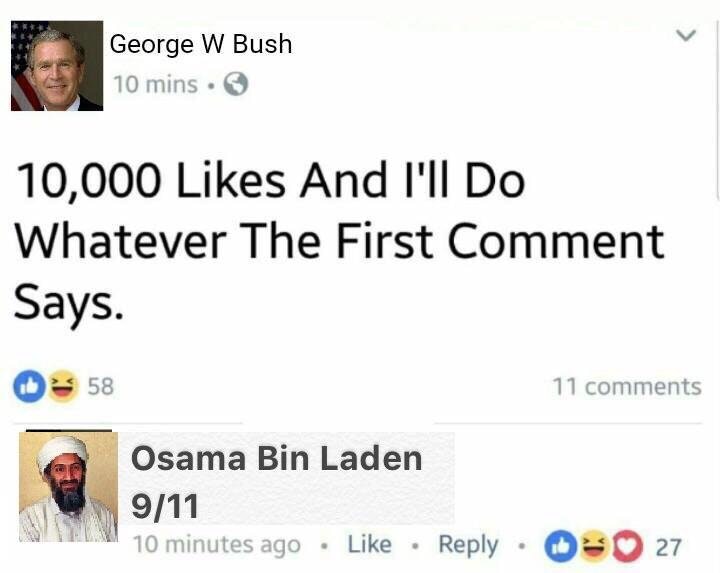
The picture imitates a Facebook post. At the top is the name "George W Bush" and a photo of a man in a suit against a flag, with the text below reading: "10,000 Likes And I'll Do Whatever The First Comment Says." Below the post are 58 reactions and 11 comments.
The key element is below the post: the first comment, from an account called "Osama Bin Laden," with a photo of a bearded man and the text "9/11." It got 27 reactions. The whole joke rests on the contrast between the promise and whatever the first commenter actually chose, with the comment's text itself serving as the unexpected punchline.
History of its origin
It's known that the template appeared in September 2017. On September 4, 2017, a Reddit user posted a parody of the popular social-media trick to the r/dankmemes subreddit, while also poking fun at another subreddit devoted to similar posts. The post quickly gained more than 750 points. The format's predecessors are said to include old memes about asking for a million likes on Facebook, as well as a promise-based game mechanic that Reddit users had come up with earlier.
The next popular version was a post featuring George W. Bush, in which the comment suggested "Invade Iraq." It gained more than 33,000 points and became, at the time, the most popular example of the template. Within a day, dozens of new versions appeared in the subreddit, and a joke featuring Trump gained more than 10,000 points. A separate branch consisted of versions featuring political and historical figures who could be cast as either the "author" or the "commenter."
The "Bush Did 9/11" version
One of the best-known branches of the meme is the version where the first comment turns out to be "9/11," posted as if from Osama bin Laden. This joke plays on a popular internet conspiracy theory claiming that the Bush administration was involved in the September 11, 2001 terrorist attacks. The theory is not supported by any serious evidence, and the meme itself is ironic about its spread.
This version falls under political humor, and its point lies in the grotesque juxtaposition of an ordinary social-media format with one of the most tragic dates in recent history. The joke depends on understanding the context: without knowing the theory, it looks meaningless. That's why versions with this comment appeared more often in political discussions than in entertainment compilations.
Why the template works
The meme relies heavily on the recognizable Facebook interface: the gray frame, reactions, comment counters, and avatars. Any social-media user is familiar with promises like "like this and I'll tell you," so the format reads instantly. The parody heightens the effect, turning a harmless request into a condition that a random stranger ends up fulfilling.
The template's comic power lies in the gap between the promise and the result. The post's author seems to take responsibility, and the first comment completely hijacks it. Since the choice of action is handed over to the audience, the template easily adapts to any topic, from celebrity jokes to historical ones. It's precisely this flexibility that explains why the format outlived its specific versions and keeps appearing in new contexts.