The visit of five little police officers
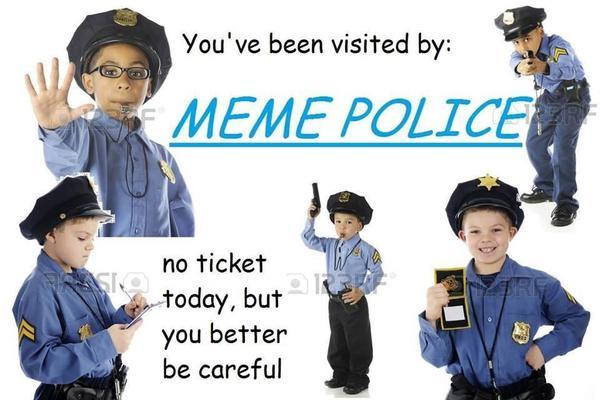
On a white background several photographs of children in police uniforms are assembled. One raises a palm, another writes something in a notebook, another holds a badge, and a child at the top of the image holds an object that looks like a pistol. Above the large blue caption “MEME POLICE” stands the phrase “You've been visited by:”; below it is the warning “no ticket today, but you better be careful.” The montage shows a stock-photo watermark. The image plays on the mismatch between childish faces and the stern language of a police warning.
Instead of a real law, here the fantasy of inspectors who grade memes and write fines for a failed joke is at work. The visit looks both solemn and absurd: there are many people in the photo, yet their promise is limited to a harmless “no fine today.” The image is easy to carry over to other topics, since it is enough to swap the agency or the reason for the inspection.
One policeman and a fine for a bad meme
A dated version with a single stock photo of a child in a police costume appeared on August 13, 2013. The child holds a notepad and seems to be writing a citation, and the caption announces: “ur gettign a ticket sir, that meme wasn’t dank enough.” The misspelled words sit alongside the address “sir” and the language of official procedure. Because of this, the stern tone sounds like a mask that an amateur internet joker has put on. The word “dank” here signals approval of the meme, and the invented accusation boils down to the joke not being good enough.
There is no precise definition of such a “violation”: one viewer may find the picture funny, another outdated or too banal. The policeman turns this dispute over taste into a parody of an indisputable decision by authorities. A small child in a big uniform further undercuts the seriousness of the verdict. The result is a reaction to someone else's post in which dissatisfaction is dressed up as paperwork, even though the whole “investigation” took one glance at the meme.
The 2015 montage expanded the “department”
By 2015 variants assembled from several stock photos of children in uniform had appeared. The montage with five policemen belongs to this branch: instead of one hero, the viewer is greeted by an entire team with different gestures and objects. The caption softens the threat (“no fine today”) but promises that the police are watching. Later, faces in similar images were replaced with characters from games, cartoons, and other memes, and the text was adjusted to fit a new reason for a “visit.”
The early text about a meme not being “dank” enough combined a deliberate misspelling with the look of an official fine. The group version removed the specific verdict and left only a warning, so it can be used both as a self-ironic reminder about the quality of a post and as a parody of people who insist too strictly on community rules. The history of the format shows a shift from a single snapshot to a universal character, not the emergence of a real organization.
Invented reasons for a visit
For example: “You called a screenshot a ‘meme’ again,” and the Terminology Police arrive at the post: “No fine today, but we'll hear your explanation.” Or: “Someone in the chat posted the same cat meme for the fifth time,” and the Repeat Police hand over a ticket numbered five. Another option: “Announced this meme as the last one, then a minute later sent ten more,” and the Promise Police arrive with a folder of unfulfilled pledges. The stern gestures of the little policemen allow a trivial offense to be played out as if an entire department were investigating it.