What is in the picture
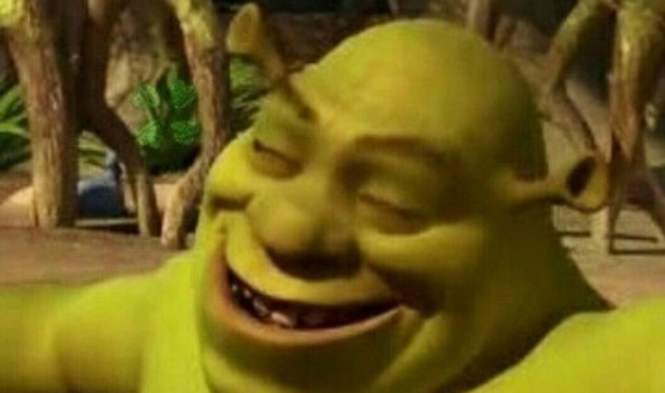
The image is a close-up of Shrek’s face, green with a yellowish tint. His eyes are almost completely shut because he is laughing, his mouth is wide open, and his teeth are visible. One ear sticks out to the side, and his head is turned slightly away from the camera. An outstretched arm comes in from below, which makes the frame look like a selfie.
The background is blurred: tree trunks and greenery that suggest a forest setting. The picture is small and grainy, with saturated colors, like a file that has been re-saved many times. There is no text on the image itself; the slang word exists only in the meme’s title. No swamp or mud is visible in the frame.
The word and its mood
The meme’s title is a slang word whose root is a vulgar expression. In speech it is used as praise and an exclamation of delight: people say it about something very pleasant, cool, or successful. The vulgar root is barely audible, though: the word’s intonation is cheerful and approving, and in captions it is used as an emotion, not as a curse.
Where and when the word appeared is not known for certain. Some reports say it spread through Russian-language communities and VK comments around the beginning of 2019, but this is a rough estimate. The first author is unknown, so no exact date can be given.
Where Shrek comes from
Shrek is the hero of the animated film “Shrek” from DreamWorks, released in 2001. It is based on William Steig’s 1990 children’s book “Shrek!” Since then the character has become one of the most recognizable heroes of Russian-language memes: his frames are happily used for both serious and absurd captions.
Which film this frame comes from and which scene it is taken from is unknown. Its resemblance to episodes from different parts of the franchise makes it hard to name a source with confidence, so it is more honest to say that the origin of this particular image has not been established. For the joke this does not matter: the viewer only needs to see a happy face.
Three captions in one tone
“Came home after work, and there it is, happiness.” The caption sets up an ordinary everyday occasion, and the hero’s wide grin turns it into delight. The laugh comes from the gap between a small thing and a huge reaction.
“Found the last slice of pizza in the fridge.” The joy is almost childlike, which is why it is funny. The squinting eyes in the picture set the tone: the person is genuinely pleased and not hiding it.
“They said it would rain, and he went out for a walk anyway.” Here the twist is unexpected: the expectation is of something bad, but the emotion is positive.
All three examples rest on small things that look like enormous happiness to the hero of the frame, that is, to Shrek himself.
Why the grin works
A wide grin with squinting eyes conveys emotion without words. The viewer reads the delight at once, and the caption only specifies what caused it. That is why a short caption is stronger than a long one: the face has already said everything.
For captions, it is best to choose small things that seem important to the hero himself: food, a day off, a found object. Then the joke rests on contrast rather than mockery. The background hardly matters; the face is the main thing in the frame, so captions should not be overloaded with detail or describe what is already visible.