What is depicted
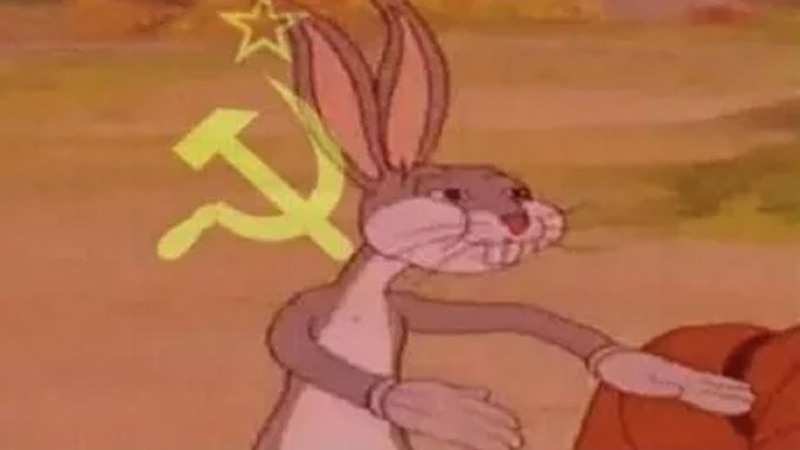
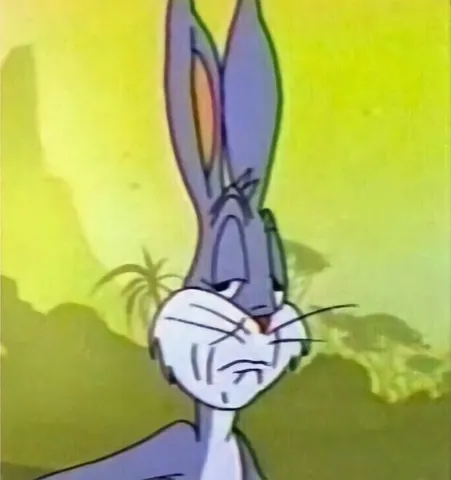
The frame shows Bugs Bunny: gray-white fur, long ears, a broad smile and a sidelong glance. His arms are spread to the sides, as if he is inviting everyone to join in. Behind him, on a golden-orange background, a yellow hammer and sickle with a five-pointed star above them are laid over the drawing. The emblem looks like graphics added later.
The red filter some write about is absent in this version: the background is warm, sandy-yellow. The atmosphere of a “revolutionary poster” is created precisely by the golden symbol and the grand pose.
Where the frame comes from
Bugs Bunny is a character of the Warner Bros. studio. According to the generally accepted account, his official debut took place in the cartoon “A Wild Hare” from the Merrie Melodies series on July 27, 1940. According to reports, the original frame with the outstretched arms is taken from this cartoon, and the emblem was added to it later, online.
The first notable publication of the meme, according to the same reports, dates to June 2020: the picture was posted on Imgur with the caption “Prove me wrong.” Later it spread to Reddit, Twitter, Instagram and iFunny. The exact author of the edit is unknown.
What the hammer and sickle means
The hammer and sickle is the emblem of the Soviet Union, a symbol of the alliance of workers and peasants. In memes it works as a conventional sign of communism, not as a historical document. The picture says nothing about the real views of its creators or the studio: it is a play on an image.
Bugs’s pose strengthens the joke. He looks like an agitator ready to explain why the common good is better than the personal. A familiar children’s character and a serious political symbol create a comic clash.
How the joke works
The basic format: a phrase about property is reshaped into “ours.” For example, “my salary” becomes “our salary.” The result is a joke about a person who very willingly shares other people’s things.
The second format: the picture is attached to a statement in the spirit of “Let’s split it equally.” If the author asks to share food or a game account, it looks both like a request and like a manifesto.
Caption examples
“My Wi-Fi password” → “Our Wi-Fi password.” A joke about neighbors and guests who instantly consider the internet shared.
“Your sandwich is our sandwich.” A classic everyday joke about those who share someone else’s food.
“My bonus” → “our bonus, if you filled out the paperwork.” A joke about how personal luck suddenly becomes shared when it benefits others.
“My turn on the account?” — “The account is shared.” A gaming version for friends who share one account.
Usage tips
The picture works best in everyday contexts: food, passwords, things, the queue for the console. Political captions call for caution: a joke can easily turn into an argument, and the topic of communism has a complex and painful history in different countries.
Keep the caption short and understandable without explanation. The principle “mine became ours” is transparent enough, and extra words only get in the way.
Another advantage of the picture is that it is not tied to a specific era or country. A cartoon rabbit and a symbol from a history textbook are equally familiar to readers of different ages, so the caption can be written in any language, and the meaning “common instead of personal” is clear without translation. That is precisely why the joke travels so easily from one group of friends to another.