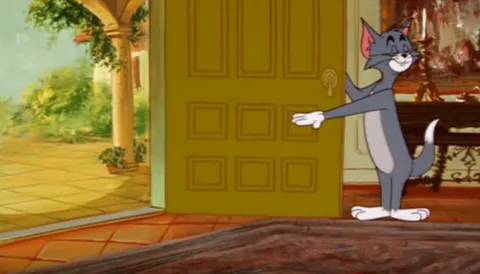
The gag from “Mouse Trouble”
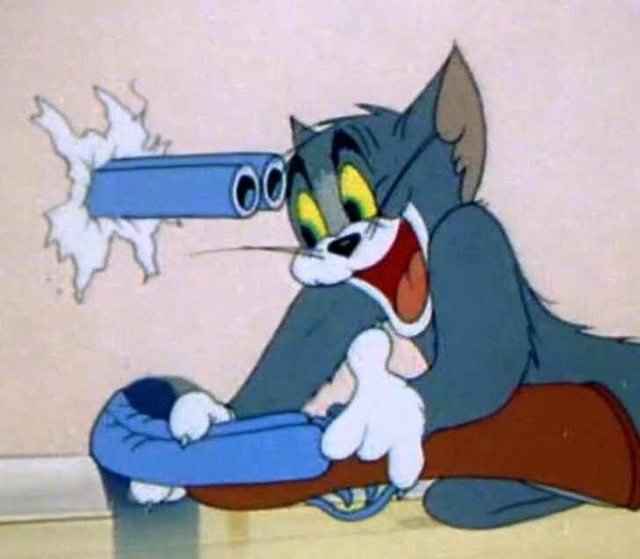
The frame is taken from the MGM short “Mouse Trouble,” directed by William Hanna and Joseph Barbera and released in 1944. In this episode, Tom tries to get to Jerry through a mouse hole. The cartoon builds the joke on impossible geometry: the gun passes into the wall and comes out the other side so that it ends up aimed at the cat himself. This is not a realistic depiction of handling a weapon, but the conventional mechanics of an old animated chase, where space instantly obeys the punchline.
In later online use, one frame separated from the sequence. In March 2015, a screenshot of the scene already appeared in an internet joke. At first the viewer saw the entire gag inside “Tom and Jerry”; then the meme macro turned it into a standalone scheme: a person plans an action against an external target, and the result lands on themselves.
What exactly is visible in the meme frame
Tom kneels and smiles, holding a gun with a wide bend in the barrel. The muzzle on the left points at his head; a flash captures the moment of the shot. The mouse hole and the gun’s passage through the wall are not shown in this variant: only the cat himself and the clearly visible reverse path of the barrel remain. Tom looks pleased, as if the plan has already worked, while the viewer sees where the shot is aimed. The whole joke fits into the gap between the character’s knowledge and the viewer’s: the cat is sure of his trap, but the image shows its reverse effect.
The meme is usually used not to describe literal violence but to describe the result of one’s own actions — especially when a person doesn’t notice the obvious side effect. Importantly, the picture alone doesn’t show the whole outcome of the episode; it captures the extreme moment before Tom realizes his mistake. That is why the caption should name the intention or cause, while the visual part pushes them to absurd self-sabotage.
From mouse hunting to a self-reversing move
In the short cartoon, this is part of the physical comedy: Tom again builds a clever plan to catch Jerry, but the cartoon world turns the trap back on him. In the macro, this specific hunt often disappears; what remains is the more general mechanism of “causing a problem for yourself.” Hence the variants about trying to tidy up that sets off even more chaos, or about automation that required more work than the manual action. The humor rests on a confident start and an ending visible to the viewer, not on the hero seeming to want harm for himself.
The image fits especially well when the goal and its consequences are linked by one action. If a person sends a reminder to all colleagues and accidentally replies to everyone with a complaint about that reminder, the “gun” turns back on its author with their own tool. If it’s merely a random mishap from outside, the causal link disappears and the joke becomes strained.
Invented reverse effects
“I made a group chat so I wouldn’t have to answer questions one by one; now I’m answering fifty notifications at once” — the plan comes back to its author. “Set a reminder to stop reminders — and woke up to two alarms” — the system creates the noise it was supposed to remove. “Closed all the tabs to speed up the browser, but along with them closed an unsaved document” — a confident decision turns into a loss of work. These are invented examples; in each one, the hero doesn’t know what the viewer has already worked out from the picture: the reverse ending of his cunning is aimed at himself.