What is depicted
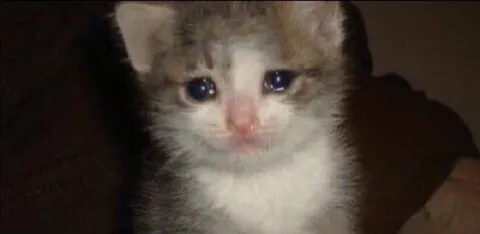
The picture shows a white-and-gray cat in a close-up: dark fur along the edges and on the ears, a light muzzle. Its mouth is wide open, with a pink tongue and sharp fangs visible. Its large dark eyes shine, and there are drops beneath them that look like tears. The background is light and blurred, and the image itself is heavily compressed and grainy, like a file saved many times over.
The tears were reportedly added during editing: the original photo had none, and the edited version appeared later and became the standard template.
How the photo appeared
The original frame was posted on August 15, 2015 by a Tumblr user: a photo of their white-and-gray cat named Inky, captioned “struggle.” About three days later, another user posted an edited version, which became the basis of the meme.
From there the picture spread across social networks and forums. The specific day of mass distribution is not reliably documented, so it is only safe to say that the photo is older than the meme.
Why the caption “Yamero” fits
The word “Yamero” is often placed next to this cat. In Japanese it means “stop,” and the picture is sometimes called the Yamato cat. The word adds the sense of a request to the cat’s expression: the cat is not just screaming, it is demanding that whatever is happening be stopped.
The mechanics of the joke are simple: a minor annoyance is presented as a tragedy. The more absurd the reason, the stronger the contrast, and the humor rests on that.
Four captions for your own version
“Monday has started, and the spreadsheet got renamed again.” The reason is everyday, the reaction is epic. The joke works on the gap between the cause and the emotion.
“The neighbor turned on a drill at nine in the evening, Yamero.” A short plea at the end adds character: the cat does not explain, it demands.
“Read the teapot’s instructions all the way through.” The reaction looks honest, because the tone of the picture matches the reader’s weariness.
“Asked to cut the presentation to five minutes, and it runs twenty.” The caption uses an expectation and shows that it was broken. The cat becomes a witness, not a participant.
How not to overdo the template
The template relies on exaggeration, so it is better used for everyday irritants. It works poorly when someone else’s real misfortune is involved: then the caption stops being funny and looks like mockery of a person.
It is worth keeping one precise trigger and one reaction. If a third trigger is added, the joke falls apart, and the reader does not understand what exactly the cat is reacting to.
Because the picture is recognizable, a short caption works better than a long one: the cat’s expression replaces the emotion, and explanations only get in the way.
One more observation: because of the poor quality of the photo, the template travels well across mobile feeds. The graininess does not get in the way and even helps, since the emotion is read from the open mouth and wet eyes in a split second. Pictures like this live in fast chats, where the reader does not dwell on the caption.
For the best effect, the caption should be written from the cat’s point of view: not “I don’t like Mondays,” but a short phrase with a concrete irritant. Then the joke becomes a mini-scene where it is clear who is screaming and why.