Two frames and one voice
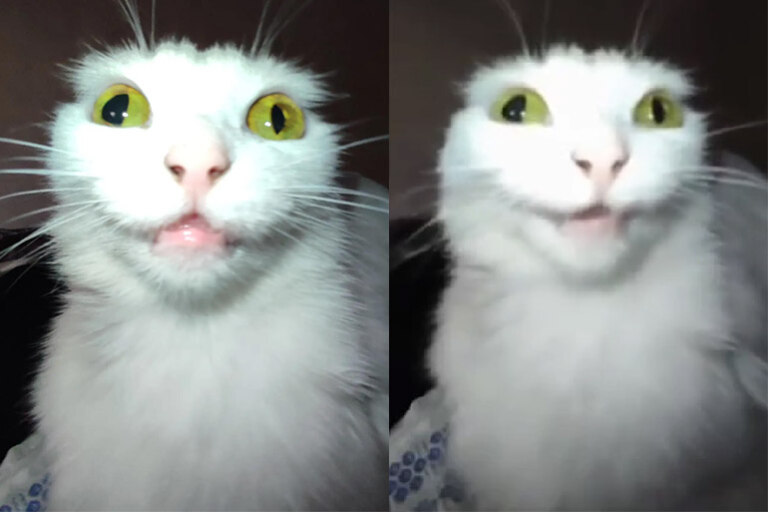
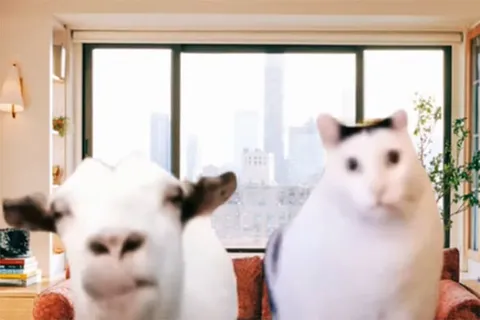
The image shows a white cat in close-up across two similar frames: in one, its mouth is slightly open; in the other, it looks closed. A pair like this is easy to read as a moment of speech or a change of expression, even though the still picture itself says nothing. In videos, the image was paired with the voice of blogger Margarita Skarri and her lines about coffee, food, and everyday life. Exactly when and by whom the cat image was first combined with this recording hasn't been reliably established. An earlier Chinese wave has a separate line of its own: a white cat lip-syncing to a popular song in clips with a synthesized, animated mouth.
How the image starts to talk
The viewer hears a human voice and automatically attributes it to the cat. Even a simple switch between two frames creates the sense that the lips are moving in time with the words. The huge eyes and the barely moving face add a sense of impassiveness: the cat looks as if it's seriously commenting on ordinary everyday events. Voice fragments with a consistent intonation become quotable, and editing lets them be transplanted onto new situations. This is less a story about a talking animal than comedy of appropriation: a human observation comes out of an unexpected 'face' and so feels disproportionately important.
Two caption examples
'I bought food storage containers. Now I have food storage containers.' The repetition is built like a pseudo-profound confession: the speaker announces a simple fact with the intonation of a final revelation. On the white cat, a line like this sounds especially solemn and, at the same time, completely empty. It works for everyday self-irony, but not for mocking someone's actual hardship or financial trouble. The cat's motionless huge eyes only reinforce this false solemnity, turning a minor purchase into what looks like an important observation.
'Starting Monday I'll plan my downtime. First I'll make a spreadsheet for the downtime.' The second line instantly cancels out the promised rest, and the serious voice turns self-organization into something close to a research project. A tiny pause fits neatly between the open-mouth and closed-mouth frames right before the word 'spreadsheet' — and that's exactly where you hear the bureaucratic turn the cat falls silent for, for just a second.
Situations for 'White cat talks'
It fits short monologues delivered on a pet's behalf, self-ironic everyday observations, and situations where a small habit gets presented as an important life theory. On a still image, one line is enough; in a video, it helps to keep the pause and the distinctive intonation of the original audio, so the viewer has time to accept the cat as the one speaking. The template quickly loses its punch if you substitute a long story with no recognizable intonation, or attribute real medical or political claims to the animal. If a specific voiceover is being quoted, it shouldn't be passed off as the cat's literal words or as the pet owner's own authored text.
The unknown is part of the story too
Sources describe several overlapping branches: Chinese clips of a cat 'singing' Super Idol, and Russian-language videos with Margarita Skarri's voice. The reliable origin of the image itself, and the identity of whoever first paired it with this voiceover, remain unknown. Some posts only suggest that the photo resembles shots of a cat from user accounts; that's not enough to call the animal an established author or the hero of the original. So a safe description keeps the well-known voice meme separate from the uncertain origin of the picture.