What is drawn in the picture
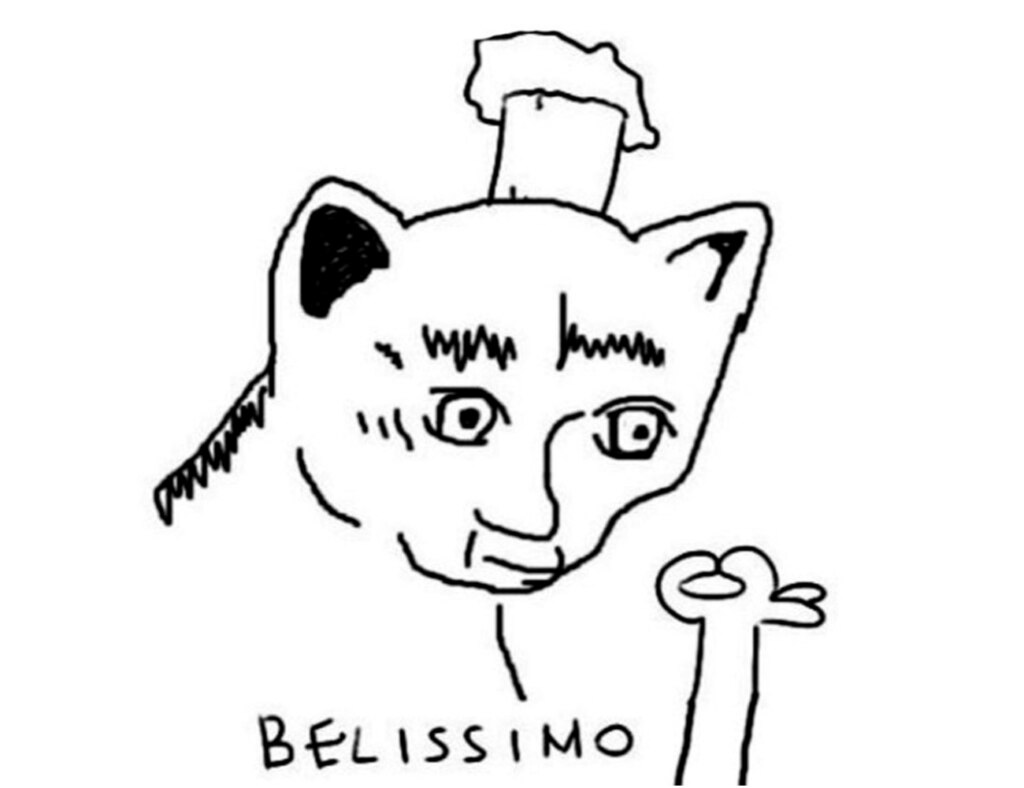
The drawing is done in black line on a white background, almost like a marker sketch. The cat is shown in three-quarter view: a large head, one ear filled in black, the other only outlined, and short strokes of fur on the cheek and around the muzzle. The eyebrows are drawn as bunches of short lines, the eyes are round with dot pupils, and the gaze is serious and slightly wary.
A tall chef's hat stands above the head: a straight cylinder with a puffy, uneven top. On the lower right a paw is raised with curled fingers, resembling a gesture of approval. Under the muzzle, in large block letters, “BELISSIMO” is written. The drawing is deliberately clumsy, and half of its charm lies in that: naive lines make the solemn praise funnier.
The word and gesture it alludes to
The caption resembles the Italian “bellissimo”, meaning “very beautiful” or “wonderful”. The spelling with a single “l” conveys either a mistake or a playful pronunciation, and such imprecision is quite in the spirit of internet humor. The chef's hat hints at what it is about: the cat seems to have tasted a dish and is satisfied.
Close in meaning is the English expression “chef's kiss”, used to describe something flawless, with a kissing gesture of the fingertips. Neither the exact date of the drawing's appearance nor its author has been reliably established, so the cat's origin can only be described in general terms: it is an anonymous hand-drawn reaction to something tasty and successful.
Why it works as a reaction
The main device of the meme is incongruity. A solemn Italian word and the pose of a gourmet are applied to a simple situation: a sandwich, a bill found in a pocket, a fixed outlet. The more modest the occasion, the funnier the praise sounds.
The second layer is smugness. The cat is neither surprised nor moved; it delivers its verdict confidently, like someone who foresaw everything. That is why the template is especially good for self-irony, when the author praises their own decision and knows the occasion is tiny.
Caption examples
Four independently invented examples for this template.
“Found a forgotten cheese in the fridge, dinner is ready. Belissimo.” A minor stroke of luck is presented as a culinary event, and the contrast between the cheese and the solemn word creates the joke.
“Wrote the report ten minutes before the deadline, and there are no typos in it.” Relief is passed off as mastery: the cat accepts the work as if everything had gone according to plan.
“Over-salted the soup, but served it with dignity.” The funny part is the pause between admitting the slip and the gesture of delight: the speaker is clearly pleased with themselves despite the obvious.
“The code compiled on the first try. That was the plan all along.” The success is declared to be the intention, and the irony rests on that self-confidence.
When the template fits
The caption is best kept short: one phrase and a verdict word. The meme suits praising food, small wins and good decisions, as well as self-irony.
It works worse when it is used to praise someone's appearance or to cover up mockery of someone. Then the cat stops being funny and turns into a tool of malice. The image of a mustached Italian chef easily slides into a caricature of a nation, so it is better to build captions around the situation itself rather than around national traits.