What the figures depict
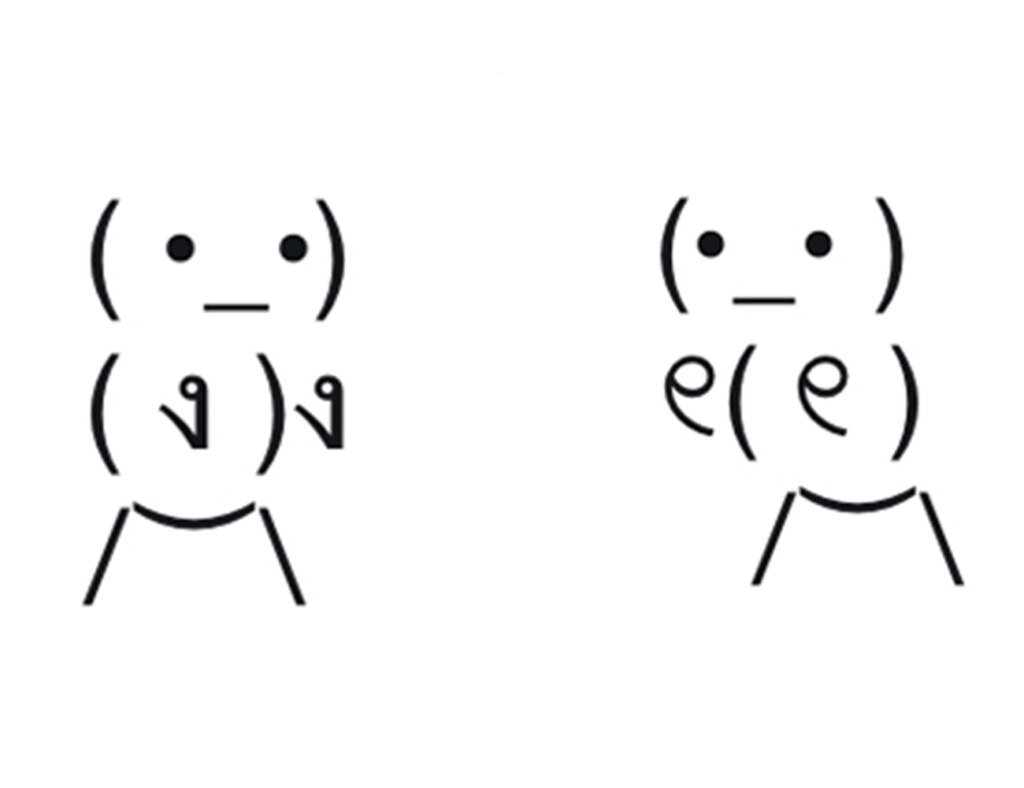
The drawing is built from text characters: brackets form the round head and torso, two dots stand for eyes, and an underscore for the mouth. The arms are separate marks resembling clenched fists: the left figure's are raised in front of the body, and the right one's are also pointed forward. The legs are two slanted lines under a curved arc.
On a white background there is no caption or frame, so the meaning comes from the poses alone: two identical figures stand facing each other, and each is ready to fight. This very simplicity made the drawing recognizable in the feed.
History of the format
This is a meme in text-graphics format, that is, an image assembled from characters. The earliest known example is said to be a Portuguese-language tweet from April 6, 2019, describing a dream in which two members of a pop group fight.
Within a few days variations appeared in which the opponents changed: “savings” against “spending,” and in the English-speaking world, a person against the urge to cry. The example found is not necessarily the first, so the origin date should be treated as tentative.
It is also important that the format quickly separated from the specific joke. Once invented, the drawing became a universal template that can be filled with any two conflicting desires, which is why it appears in many variants.
How the conflict works in the joke
The point of the format is that the opponent is rarely external. More often it is one's own desire, fear, or habit pulling in different directions. That is why the two figures are convenient to place beside the thought “I versus...”.
The visual parody here is of a serious gesture: boxing usually means a real bout, while the tiny symbols make it almost toy-like. The contrast between the dramatic pose and the simple drawing is what draws a smile.
In addition, the format is good because it does not require drawing skill: the figures are easy to copy and paste into any chat, and two short captions on the sides are enough to make a complete joke.
Caption examples
Example 1. “Inner voice versus sleep at three in the morning.” One figure reaches for the phone, the other for the pillow, and the viewer immediately understands the fight is happening inside one person.
Example 2. “Salary versus credit card.” The caption turns everyday struggle into a sports bout and shows that even ordinary expenses can look like a fight for balance.
Example 3. “Me versus the urge to finish the cake.” The humor lies in the fact that the opponents are clearly evenly matched: the joke rests on an honest uncertainty of outcome.
Example 4. “Me yesterday versus me today.” The caption moves the conflict across time and shows how the same person argues with himself, which is easy to recognize and reads as good-natured irony.
How to choose a caption
It is better to pick opponents who can genuinely contend: two solutions, two desires, two habits. If the opponent is incomparable, the joke loses its balance and turns into a simple comparison.
A short caption above or below the figures works better than long text. The viewer should see both sides at once and understand who is in which corner.