What the emoticon is made of
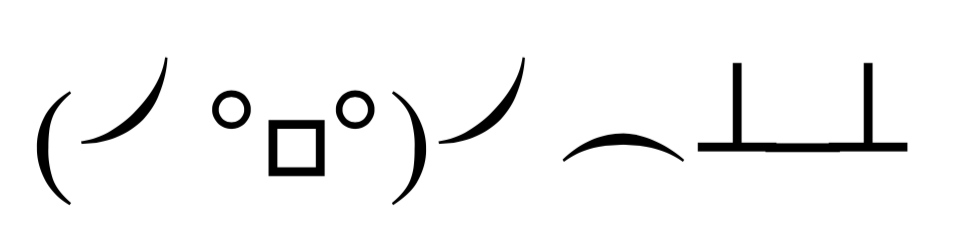
In the picture, the emoticon is written in black characters on a white background. On the left are round brackets with raised arms, in the middle a face made of circle eyes and a square mouth, and on the right a flying arc and a table made of the ┻━┻ symbols. Taken as a whole, it forms a scene: a person has flung up their arms, and the table is already flipping.
Unlike ordinary emoticons, such faces have to be read by tilting your head, and that is exactly why they are remembered even without a caption. The characters come from different symbol sets, so the emoticon can easily be pasted into any text where ordinary characters are supported.
The Japanese precursor of the gesture
Japanese culture has a gesture called “chabudai-gaeshi”: a comic character in anger flips over a low dining table. This motif appears in Japanese popular culture of the second half of the 20th century, for example in popular manga and television comedies. A direct link between these works and the text emoticon has not been proven, so any influence can only be treated as a hypothesis.
Two things must be distinguished: the existence of the gesture in Japanese culture and the appearance of the text emoticon on the internet. They are related in meaning, but it is not known who first recorded the scene in symbols. The author of the emoticon and the date of its first appearance remain unknown, and the versions about the early 1990s remain assumptions.
How the emoticon reached games and forums
In the West, the emoticon's popularity is linked to online games and forums of the early 2010s. Players used it to show anger at a failure in a match, and then it moved into general discussions, where it became a universal sign of irritation. Specific dates and first examples differ across sources.
The format then became part of the language of messaging: the emoticon is placed at the end of a short remark, and it immediately turns the story into a small scene. Over time, variants appeared: the same table is returned, several tables are added, or the character is changed.
Example captions
Three captions written for the emoticon. It responds to a minor problem, and the contrast between the dramatic gesture and the occasion is what makes the joke.
“Assembled the wardrobe following the instructions, and one extra part was left in the box. (╯°□°)╯︵ ┻━┻” An ordinary, almost dull story gets drama, and the difference is clear at once.
“Reached the final level of the game, and the server crashed on the last stage. (╯°□°)╯︵ ┻━┻” This version intensifies the emotion, because the loss feels unfair.
“A colleague said, let's quickly get this done, and the project suddenly had forty revisions. (╯°□°)╯︵ ┻━┻” The effect is built on the expectation of a small task and the real volume of work.
How to use the emoticon
The emoticon looks good in a chat or a comment next to a short phrase. One is enough, while several in a row lose their precision. The sign has no author, so it is better to describe it as a long-standing internet gesture rather than as the invention of one person.
It is placed at the end of a short phrase as an emotional full stop. It fits correspondence with friends and playful comments, but in a business letter it looks harsh, so the tone should be chosen in advance. If you need a different shade, it is better to pick another figure made of symbols than to add extra characters to this one.