What the tweet says
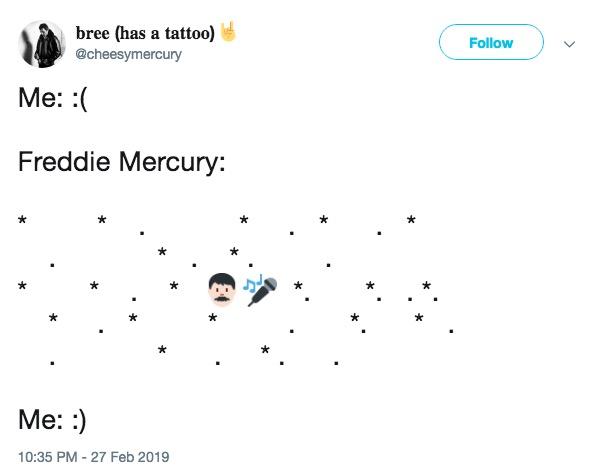
The image is a screenshot of a Twitter post from February 27, 2019. At the top is the line “Me: :(”, followed by “Freddie Mercury:”. Below is a field of asterisks and dots, and in its center is a small icon: a man with a mustache and a microphone with musical notes. At the bottom is the caption “Me: :)”.
The idea is clear without explanation. First the author expresses sadness with a familiar emoticon, then names a famous vocalist, and after that a happy emoticon appears. The asterisks in the center suggest a stage or a night sky that suddenly lights up.
How the asterisks work
The asterisks read as twinkling lights, and the dots as sparks or confetti. The empty space between them is perceived as a sky or a hall, even though everything is drawn with ordinary keyboard characters. This device combines the simplicity of text with the expressiveness of a picture.
The emoticons “:(” and “:)” have long served as a short mood marker in messaging. Here they stand at the beginning and at the end, and the difference between them creates the main effect. The viewer sees the change rather than just the outcome: first sadness, then joy, while the asterisks in the middle serve as the transition.
Why Freddie Mercury was chosen
Freddie Mercury was the vocalist of Queen, known for his vivid stage energy. In the frame he is represented by just one small icon, but a mustache and a microphone are enough for recognition. Such an image turns an abstract “good mood” into a concrete event: a concert, walking onto the stage, a sudden lift.
Choosing a celebrity works as a shorthand. Instead of a long explanation of what makes the author happy, the author shows a person with whom the viewer already has emotional associations. The stronger the image in memory, the faster the joke lands.
What is known about the origin
Who first came up with the field of asterisks with such captions is not known. The date February 27, 2019 refers only to the single tweet shown in the picture and does not prove that the format appeared at that time.
The template should not be confused with other ASCII works in which keyboard characters form a picture: there, portraits and landscapes are built from symbols, whereas here the point is not the drawing but the change of mood between two emoticons.
Examples of captions
“Me: :(, when the alarm goes off on Monday. Me: :), when it goes off on Saturday.” The caption repeats the structure of the original but changes the occasion. The meaning rests on expectation: the same alarm on a day off is perceived differently.
“Me: :(, when the chat starts talking about the deadline. Me: :), when it turns out the deadline was moved.” The effect is built on a sharp change of news. The contrast is clear even if the reader doesn't know the whole story.
“Me: :(, when the kitchen is empty. Me: :), when I find dumplings in the freezer.” A simple everyday episode gets the scale of a concert, and the exaggeration works just like the icon with the microphone.
“Me: :(, when the tests fail. Me: :), when they are green again.” This uses developer slang, but the structure is preserved: sadness, turn, joy.
How to build your own version
The formula is simple: a sad emoticon, a name or image of whoever rescues the mood, a field of asterisks, and a happy emoticon. Instead of a musician you can put any phenomenon the audience associates with joy: a favorite dish, the first warm day, a day off.
It is important to keep the field empty. The more space around the icon, the stronger the feeling of a stage or sky, and any extra caption inside the field breaks the idea. The text stays outside the picture, while the picture itself remains a clean symbol of a change of mood.