What the picture shows
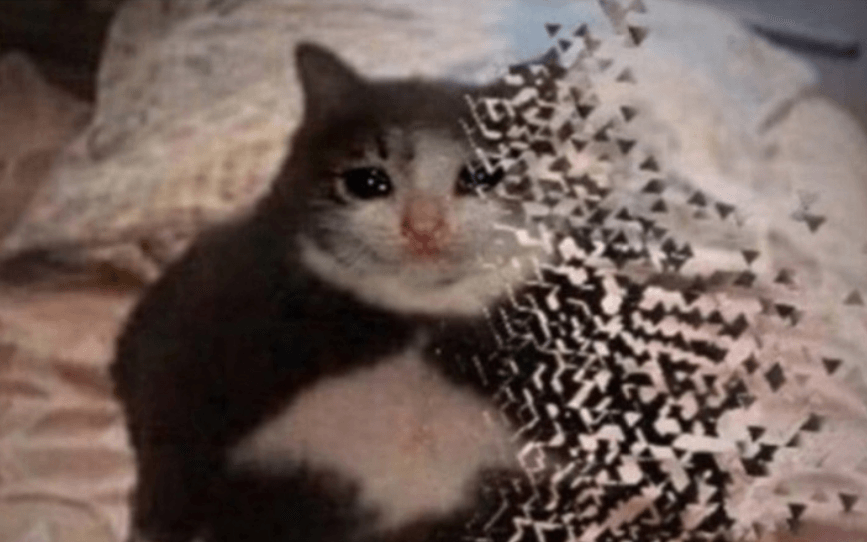
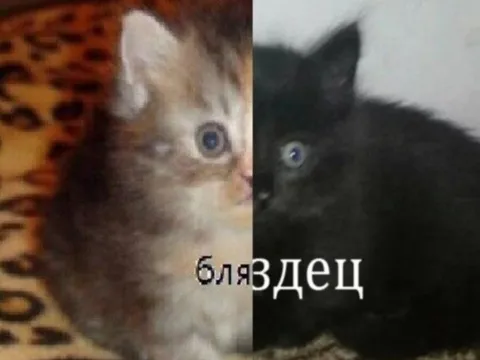
The frame is a close-up: a small cat with dark fur on its back and muzzle and white cheeks and chest lies on light, folded fabric in a beige-pink shade. The eyes are huge and shiny, the gaze directed at the camera or slightly past it, and the nose is pink. The expression is such that the animal looks about to cry.
The right half of the frame is no longer a cat but a cloud of small black-and-white triangles. They spill to the right and upward, like ash. The left part of the muzzle and the body are intact, and it is this transition from living to crumbling that makes the picture recognizable: the viewer sees the moment when the disappearance has not yet finished.
One more detail: the frame is heavily compressed, the edges of the triangles are grainy, and this helps the joke. The picture looks like something saved many times over, and this is exactly how folk memes look, rather than polished advertising shots.
How the meme was put together
The template consists of two ready-made parts. The photo of the crying cat began to be used as a meme around July 2018. The disintegration effect came from the film “Avengers: Infinity War” (2018): after Thanos's snap, the heroes crumble into specks of dust, and this visual device became the film's most recognizable image.
The version with the Russian caption “Ty chevo nadelal?” took shape in February 2020; by February 17 it was already circulating online. It was preceded by a variant with the caption “Proshchyay” (a misspelling of the Russian “Proshchay,” meaning “goodbye”). The deliberately distorted “chevo” is part of the joke: this is how one writes from the point of view of an indignant, slightly naive narrator.
The real burst of popularity came in March 2020, when the news was simultaneously full of the coronavirus pandemic, the collapse of the ruble, and discussion of resetting presidential term limits. The crumbling cat turned out to be a handy reaction to any bad news. Who exactly assembled the first version with the effect is not reliably known.
How the joke is built
The question “Ty chevo nadelal?” is addressed to someone who has already done something irreparable. But it is spoken not by an accuser but by the vanishing cat: he is both victim and witness. This produces a double contrast: a household, almost childlike reproach and a cinematic, universal catastrophe.
The smaller the reason, the funnier it is. If the caption is about the end of civilization, the joke is flat. If the caption is about a washed mug with tea stains that was kept for weeks, the cat starts working at full power: the scale of the drama does not match what happened, and you know it, and still you sympathize.
Examples for your own caption
“Me: installed the update an hour before the deadline. The project: ty chevo nadelal?” It works on expectation: the person is sure everything will be quick, and then all the work disappears.
“Mom, seeing that I decided to get a haircut myself.” Mom's reaction is reduced to a single word, while the cat depicts the consequences.
“You: hit ‘reply all.’ The whole department: ty chevo nadelal?” Here the cat is given the role not of the author of the mistake, but of the collective that watches the consequences.
“My balance after the sale.” Self-irony: the cat is the money crumbling before our eyes.
How to use the template
It is better to keep the caption short and place it in the upper part or over the beige background, where there is no detail. The strongest version is when the cause of the trouble is named as a single object or action, and the consequence is left on the conscience of the cat.
Do not use the picture for jokes about real tragedies: the frame rests on the contrast between a trifle and an “apocalypse,” and with a genuine disaster this contrast disappears, leaving only crudeness.