What the picture shows
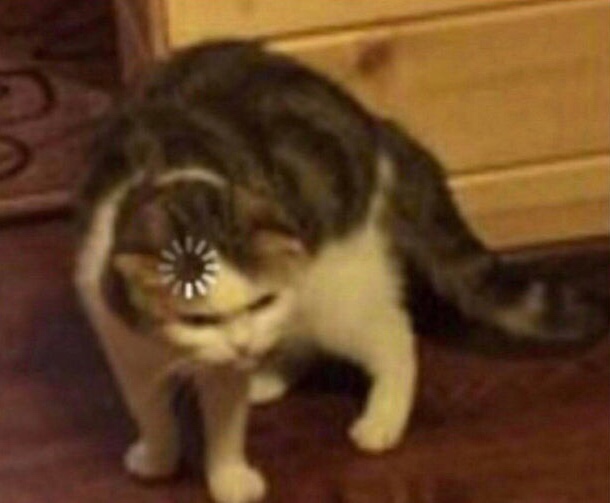
The frame is blurry and low quality. A patchy white-and-striped cat or kitten stands on a red-brown floor, its head lowered almost to the ground. A light wooden dresser is visible behind it. The pose is unusual: the head is tilted down, the body is hunched, the legs are tense, and from the outside it looks like deep thought or a forced stop. On the forehead, closer to the crown, a white loading icon made of thin rays arranged in a circle has been added. The photo looks amateur and slightly smeared.
The icon needs no caption: a spinning circle is instantly familiar to anyone who has used a browser or a video player.
The image quality matters too. The low resolution and blur make the frame look like an accidental phone photo, and this adds a homey credibility to the joke: this is not a staged shoot but a real moment in which the kitten seems to have actually frozen.
History of the meme
The original author of the photo is unknown. According to the meme catalog, the version with the loading icon appeared in July 2017; from mid-July it began appearing in meme roundups, and on August 8, 2017, a Twitter post gained considerable popularity. At first the picture spread in Russian-speaking communities, and then, in December 2019, English-speaking users picked it up, especially on Reddit.
An early, unedited version of the frame was found on a forum later than the edited one, so it does not help identify the original source. It can be said reliably only that Russian-speaking audiences knew the template before Western ones did.
Why the joke works
Comparing the brain to a computer has long been commonplace: we say “frozen,” “overloaded,” “won't load.” The icon makes this metaphor literal. The pose of an animal frozen with its head lowered confirms it: it seems that something is really being processed inside, while nothing has come out yet.
An additional plus is its harmlessness. The picture does not mock anyone and needs no context, so it fits almost any situation of confusion.
Another reason for its popularity is that the reaction is universal across age and profession. A schoolchild before a test, a driver in an unfamiliar city, and an office worker on a call all equally understand what “loading” means, so the captions require no knowledge of any plots or characters.
Caption examples
“Me when someone asks me a question right after I've just woken up.” A classic situation where the answer really does take time.
“My brain after hearing: we need to talk.” The rotating circle depicts an attempt to calculate all the options.
“Me trying to remember why I walked into the room.” An example of a recognizable everyday memory glitch.
“A coworker when asked to explain his own report.” The icon plays the role of “wait, I'll find it now.”
“My phone at 1 percent battery.” The caption deliberately shifts the joke from a person to a device.
How to use it
The picture is convenient to insert as a reply in correspondence when you need to show confusion without words. For a text caption, it is better to use short phrasings like “me when...” and not overload them with details: the frame itself already conveys the pause. Don't cover the upper part of the image, because the icon on the forehead is the main part of the joke.
You can add your own text on the icon itself, such as “processing,” “please wait,” or percentages, but these are already variations. In its original form the template works without words, and captions should be added only when the joke is not obvious from context. For a chat, the frame alone will do; for a post, one short line describing the situation is better.