What's visible in the photo
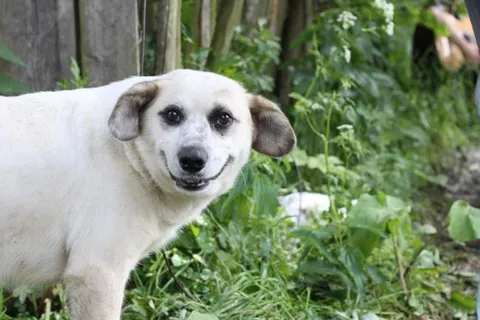
This is a plain photo with no text on it. In the frame is a small dog with white fur and a light-brown patch on its forehead and around its eyes, resembling a Chihuahua in appearance. Its eyes bulge and look slightly away from the lens, its nose is dark, its muzzle is tense, and one ear with a brown mark is slightly pulled back. The dog is sitting sideways, its body looking round and compact. On the left is a checkered armrest or cushion, above it a patch of blue fabric, and the background is dark.
The shot was clearly taken in a home setting, and there's nothing frightening about it except the look itself. That's exactly why it works so well: the expression reads as "I just realized this is really serious." But that's only the viewer's impression. What the dog actually felt, and what happened before and after the shot, is unknown.
Where this photo comes from
Who took the photo, what the dog's name is, and when it was photographed are all unknown, so none of that is claimed here. There's no confirmed date of first publication, and no information about which platform first started captioning the photo with the prayer. If you come across a detailed backstory with a year and the owner's name, treat it with caution: there's no reliable confirmation for this meme.
The main thing that's known is this: the image holds up not through the dog's biography but through a single device — the mismatch between the solemn prayer text and the pet's bewildered look, which works regardless of who's in the photo or when it was taken.
A prayer as a caption for fright
"Our Father, who art in heaven" is the opening words of the Lord's Prayer in its Church Slavonic form, one of the most famous texts in the Christian tradition. People recognize it from the first line even if they don't pray regularly. That's what makes it convenient for the joke: nothing needs to be explained, one phrase is enough.
The point of the caption is that a person in a hopeless situation jokingly "remembers the higher powers." The solemn, formal text is laid over the dog's bewildered muzzle, and the clash between the two produces the humor. The solemnity of the prayer itself isn't being mocked here: what's funny is specifically the situation of the character, who hadn't thought about the consequences until that moment.
How the joke is built
First, there's a contrast of scale at play: an ancient sacred text set against a mundane trifle like a missed deadline. Second, there's the pause: the dog's look reads as the moment between "maybe I'll get away with it" and "nope, I didn't." Third, the photo has no extraneous details tying it to a specific story, which is exactly why the caption can be changed to fit any situation, from a deadline to a banking app.
A good caption names a specific occasion and doesn't explain the emotion: the dog in the photo already does enough. Extra words ruin the pause, while the opening of the prayer comes in as the final punch.
Caption examples
"When the manager writes: 'Can you stop by, got a minute?' Our Father, who art in heaven…" — an ominous invitation with no explanation, so the imagination fills in the worst.
"Woke up ten minutes before the exam" — a caption with no prayer, where the dog's look alone conveys the fright.
"Opened the banking app after the holidays" — a familiar everyday panic everyone recognizes.
"Remembered I forgot to send that email, and it's already five on Friday evening" — sudden realization and a deadline in a single shot.
How to use the template
It suits short captions about sudden anxiety: exams, work chats, bills, unsent messages. The caption sounds best in the first person, as if the dog were speaking for you.
If you use lines from the prayer, keep them as a short final line and don't turn the joke into mockery of faith or worship: the text is dear to many people, and a joke about one's own fright lands more gently than a joke about religion. Don't invent a name or backstory for the dog: nothing is known about either.