The drawing that started a big debate
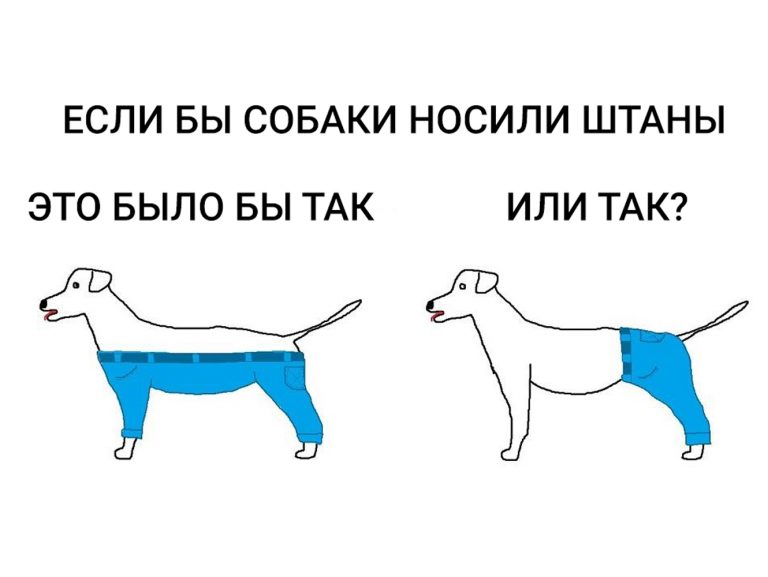
The question of dog pants was discussed even before the famous diagram appeared: in autumn 2015, variants with photos circulated online. In late December a drawing from the Facebook page Utopian Raspberry — Modern Oasis Machine, abbreviated UR-MOM, became especially well known. Its administrator, Norbert, told journalist Jared Keller that he had seen a dog in clothes and decided to draw two possible solutions.
Keller reposted the picture on Twitter and then described the ensuing argument. He noted separately that he was not the author of the drawing. The episode clearly shows the division of roles: one person made a clear diagram, another brought it to a new audience, and the participants of the discussion supplied the question with arguments and additional examples. Norbert’s claim to authorship of the drawing does not mean he was the first to come up with the puzzle itself.
Two dogs and two meanings of the word “legs”
The picture shows two schematic dogs facing left. In the left version, blue clothing covers the lower part of the body and all four legs. In the right one, pants are worn only on the hind legs, and the waistband sits near the hips. The Russian caption asks which way such clothing would look if dogs actually wore it.
The right version resembles human trousers: a waistband, two trouser legs, and an open upper body. The left follows a different rule: since a dog moves on four limbs, all of them should count as legs and get trouser legs. Both pictures follow an understandable logic but start from different premises. The diagram does not say which definition should be adopted, and that is exactly what leaves room for argument.
Why the choice so easily turns into conviction
The viewer almost instantly picks a familiar silhouette and only then formulates an explanation. Someone else’s answer can surprise, because another person finds an entirely different option just as natural. The result is a small model of an argument about words: the interlocutors discuss the same picture but put different meanings into the concept of pants. The question about fantastic clothing quietly becomes a question about what makes a thing what it is.
Clarity intensifies the effect. Both dogs stand identically, the drawing is not loaded with extra details, and the difference is marked by a single colored area. Here it is easy to compare the solutions and continue the puzzle with your own sketch. The question can be transferred to an animal with a different anatomy or to a piece of clothing built differently. With each transfer, the familiar form collides with a body for which it was not originally designed.
New puzzles for an impossible wardrobe
The first imagined version asks how a snail would wear a backpack: on its own back under the shell, or outside, over its home. Two drawings set the object’s position relative to the body against the usual idea of where a snail has free space. The most convenient solution stops coinciding with the most literal one.
In the second version, a giraffe is offered a scarf: a small one near the head or a long one along the entire neck. Supporters of the first see the scarf as an accessory; supporters of the second try to cover precisely the part of the body for whose sake it exists. The unusual anatomy again forces one to uncover the hidden definition of a familiar thing.
The third example returns the argument to people: “If a snowman wore mittens, where would he put them — on the branches or on the snowballs next to him?” The question remains a toy one, but it allows arguing about the difference between a body part and its image. As with the dog pants, a convincing answer depends on a rule the participant managed to accept silently.