What upyachka is
Upyachka is at once a joke, a slang, and a small community. The meme's entry names the movement after the abbreviations UPCHK and UP4K, which users wrote in chats and captions. Its point usually boils down to fighting empty time-wasting online: posting absurd pictures, writing ridiculous phrases, and turning boredom into a reason to connect.
It's important that upyachka has no official structure or leaders. Participation is defined by a willingness to back the joke and use its language, so the movement exists more as a shared manner than as an organization.
Origins on Lepra
The meme that upyachka formed around appeared in 2006 on the site Lepra, one of the oldest Russian-language communities where jokes, comics, and pictures were posted. The exact circumstances of the first post and the author's name are not known.
Lepra was fertile ground for phenomena like this: users quickly picked up successful pictures, came up with sequels for them, and turned them into stable catchphrases. Upyachka turned out to be one such example, where a single picture became the seed for an entire subculture.
The image and the language
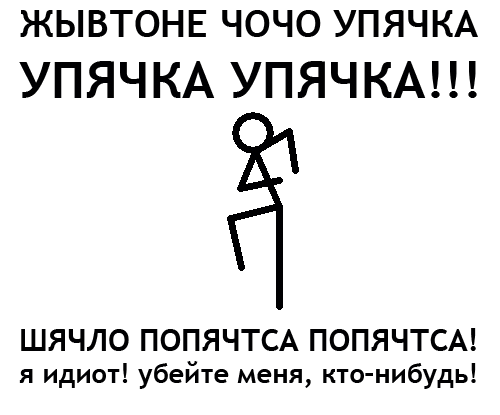
The image itself is simple: a white background, a schematic stick figure with raised arms and one foot planted on the ground, and large captions above and below. The top line is written in deliberately distorted language, and the bottom line contains a short bit of self-deprecation that instantly sets the joke's tone.
It's exactly this distorted speech that became upyachka's main hallmark. Words are respelled with errors, letters are swapped, and the phrases sound like the speech of someone trying to grab attention by any means necessary. This style is easy to recognize and easy to copy, which is why the meme's language quickly spread beyond the original picture.
The self-deprecating caption at the bottom deserves a separate mention. It sets the main tone: the author openly admits the absurdity of what's happening and seems to be asking for help, but does it in a joking way. Thanks to this duality, upyachka was perceived not as an aggressive stunt but as a good-natured game played at one's own boredom.
Community and the fight against boredom
Upyachka brought together people tired of repetitive topics and formulaic conversations. Participants invented their own rules, looked for new forms of absurdity, and backed each other up in the comments. The "fight against boredom" slogan underscored that the movement's point wasn't a serious goal but the game itself.
Over time the community became part of the broader culture of internet jokes, where subcultures like this spring up and fade away quickly. Upyachka kept its recognizability precisely through its language and imagery, which are easy to spot even without knowing the history.
How it's used today
Today upyachka gets brought up as a nostalgic joke or a short line in a chat. Writing one of its characteristic words or sending the picture is enough for the other person to get the hint. Using it this way doesn't require knowing the whole history, but for those who were around during the movement's heyday, it sounds like recognizing one of their own.