The drawing and the caption
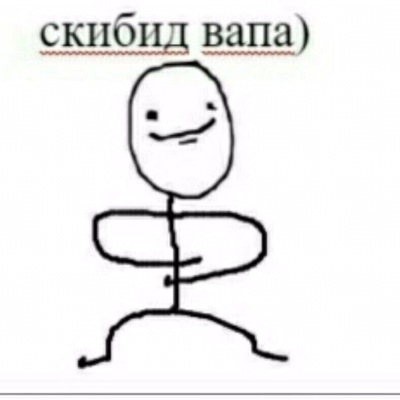
On a white background is a figure drawn in the style of a basic graphics editor. The head is an oval: a dot for an eye and a crooked grin that makes the face look sly. The torso is a single vertical line. The arms form a loop at belly level, as if the figure is holding them at its waist. The legs are spread wide and bent at the knees, with the feet turned outward.
Above the figure is the caption “skibid vapa)” with a closing parenthesis in place of a smiley. Beneath the words runs a red wavy line, the kind text editors draw under words missing from the dictionary. The parenthesis and the underline give the frame a careless, homemade tone.
The song the word hints at
The word “skibid” refers to the song “Skibidi” by the St. Petersburg band Little Big. The song and its music video came out on October 5, 2018, on the same day as the album “Antipositive, Pt. 2.” The credited authors are Ilya Prusikin and Lyubim Khomchuk, and on February 22, 2019, the song was reissued as a separate single. A later “Romantic Edition” version also appeared.
The song came with a dance. The band invited listeners to film their own videos with these moves, and that is how the “Skibidi Challenge” began. The dance spread as a meme in late 2018, and the story became not only about the song but also about the mass repetition of its moves.
A British television episode
Another echo dates from the fall of 2018. In October 2018, on a British political talk show, the host invited the guests to dance “Skibidi.” The attempt failed, and the episode itself spread as a meme. There is no point in describing the moves in detail. What matters is that the dance had already become a shared cultural reference point recognized well beyond Russian-speaking internet.
What is unknown about this drawing
The link between the drawing and the song follows from the word “skibid” and the wide stance of the figure, which resembles a dance step. But the origin of the drawing itself, its author and the date of its first publication are unknown. It is also unknown where the add-on “vapa” comes from: it does not appear in any information about the song. So the most honest way to describe this is as a caption-reference whose meaning rests on a general impression rather than on documented history.
The meaninglessness of the phrase is part of the device: to someone who does not know the song, the caption looks like a string of syllables, while to someone who knows it, the caption hints at the tune and the dance. The same picture works on two levels.
Sample captions
The captions below were written for this drawing.
“Monday, 9 a.m.: skibid vapa)” Sounds like a cheerful call to action, but there is no plan and no sense behind it. The gap between the energy of the words and the mood of the situation is what is funny.
“Reply to the email about the raise: skibid vapa)” An official matter gets a response that explains nothing. The more serious the topic, the funnier the caption.
“When the cat decided to jump off the shelf and misjudged it: skibid vapa)” The spread legs read as an awkward pose, and the caption turns the awkwardness into a dance.
All three captions follow the same structure: an everyday scene, then a line with no meaning. No explanation comes, and the viewer finishes the joke on their own.
How to use the drawing
The figure is easy to redraw with a different pose, and the caption should be kept together with the parenthesis, because it creates the intended casual tone. The best captions are short and about ordinary situations: morning, deadline, phone call.
The drawing does not depict a real person, so it is safer than a photo. Do not use the caption to mock the performers of the song or people who dance: the joke works on the reference, not on anyone's appearance.