What the picture shows
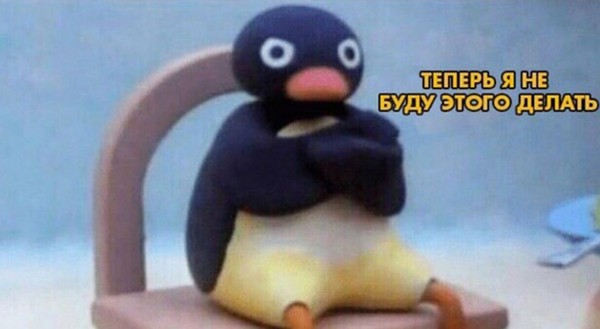
The background is bluish gray, almost without detail. In the center sits a dark blue penguin with round white eyes and an orange-pink beak. He is settled on a chair with a rounded back, his flippers crossed over his chest. His belly and feet are light, yellowish. On the right, across the image, is a yellow caption with a black outline: “Now I won’t do this.”
The caption is on the image itself, so this is already a finished meme rather than a clean template. The expression on his face is neutral: wide-open eyes look straight ahead, and it is the combination of a calm gaze and a closed posture that makes the refusal so convincing.
Where Pingu comes from
Pingu is the hero of a claymation children’s series created by the Swiss animator Otmar Gutmann. The series began airing in 1990. The original run included 104 short five-minute episodes and ended in 2000; later, a British company made a continuation, which aired in 2003–2006.
The characters do not speak any human language: the penguins communicate with a set of invented sounds, most often transcribed as “noot noot.” In the original series, the characters’ sounds were performed by the Italian actor Carlo Bonomi, while in the continuation other performers handled them. Exactly which episode the frame with the folded flippers comes from has not been established, so it is best not to tie the image to a specific episode plot.
How the joke works
The main driver of the meme is a sudden change of decision. A person was being persuaded, agreed or even promised, and now declares that they are no longer doing it. The penguin’s pose reads without any words: arms crossed on the chest usually signal closedness and an unwillingness to engage, while the childlike claymation texture makes this stubbornness cute and funny.
The word “now” in the caption matters more than it seems. It hints at a backstory: before, the person was willing, but something happened. That is why the meme works best in situations with a cause, not just laziness: offense, a broken agreement, changed terms, or sudden stubbornness.
Caption examples
“Promised to go out for a morning run, looked out the window and saw rain.” The short story ends with a frame where the decision is final and the promise is void.
“They told me the meeting would be only ten minutes. An hour has passed.” The refusal is caused by a broken agreement, and the penguin plays a person whose patience has snapped.
“When, after the third reminder about the report, my colleague finally wrote: ‘Well, forget it.’” The joke is that this is exactly what removed any desire on the assignee’s part to do anything.
“The cat after being denied access to the keyboard once again.” An everyday situation in which an animal’s stubbornness gets human logic.
Usage tips
The frame works best for a line that contains the word “now” or a hint at a reason for the refusal: that way the contrast between the earlier willingness and the new position is visible. If the caption simply states the refusal without a reason, the joke falls flat.
The meme is harmless and suits chats with friends and discussions of everyday chores. The caption is already on the picture, so if needed it is better to add an explanation in the body of the message rather than overlaying a second caption on top of the first.