An old word trap
The joke about Pupa and Lupa existed long before today’s pictures: the two heroes go to collect their pay, but the accounting office mixes up their names and hands the money to the wrong one. The comic turn rests on two similarities at once. The listener expects an ordinary mix-up over names, but “za Lupu,” said as one phrase, sounds like an obscene word. “Pupa” almost rhymes with “Lupa” and brings the story back to the original pair. The transcript of the joke, dated 2005, is an early online trace available today, not the date the joke was born.
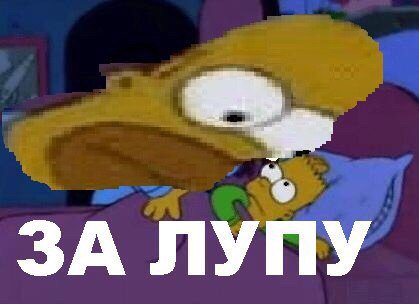
Homer and Bart instead of accounting
In the picture, Homer fills almost the whole upper frame, while Bart lies lower down on a bed; the white letters “FOR LUPU” sit along the bottom edge. There is no accounting ledger here, and the scene from the joke is not depicted. The caption sets up a double reading: at first it sounds like a short toast or an approving remark, but on a quick read a crude pun shows through. Homer’s enormous head and the recumbent Bart give the phrase an absurdly solemn setting, as if the words were said in complete seriousness.
The large white font pins the phrase to the bottom edge of the frame and makes viewers read it as a standalone line. The image does not retell who got the money in the joke; it replaces the plot with a visual contrast between Homer’s solemn look and the absurdly short caption. So the pun can be caught even without a full retelling of the accounting story, although knowing the pair of names adds a second layer.
Why similar names carry the joke
A verbal joke depends on sequence: first the listener takes Pupa and Lupa for two participants, then notices how small the difference between their names is and how the sound changes when the words are joined. In the picture, the viewer gets this shift without a story about pay: the short caption itself becomes the punchline, and the familiar heroes lend it a disproportionately epic look. The spoken version benefits from a pause before the last word; in the image, a large font takes the place of that pause, read first in pieces and then assembled into the pun. That is why variations may change the situation and the characters, but the comic effect survives only where the closeness of the names or words is still audible.
The reverse also holds: if the similar-sounding names are removed from the caption, the pun disappears too. That is why the picture relies on a familiar pair rather than on any two words with a close sound. The caption works because the viewer already knows who Pupa and Lupa are and quickly recognizes in the short phrase an old occasion for laughter.
Invented captions
Invented caption: “Pupa took Lupa’s parcel, Lupa took Pupa’s, and the pickup point closed early.” Here an everyday mix-up repeats the original principle without copying the accounting plot. Second version: “The duty roster mixed up Pupa and Lupa — now both are sure today is a day off.” The comedy rests on the consequences of the same mistake. Finally: “The first letters on the name badges wore off, and the host announced Lupa instead of Pupa.” This version suits a stage announcement but does not require the viewer to believe the cartoon characters actually bear these names. All captions were invented for this analysis.