A frame in comic style
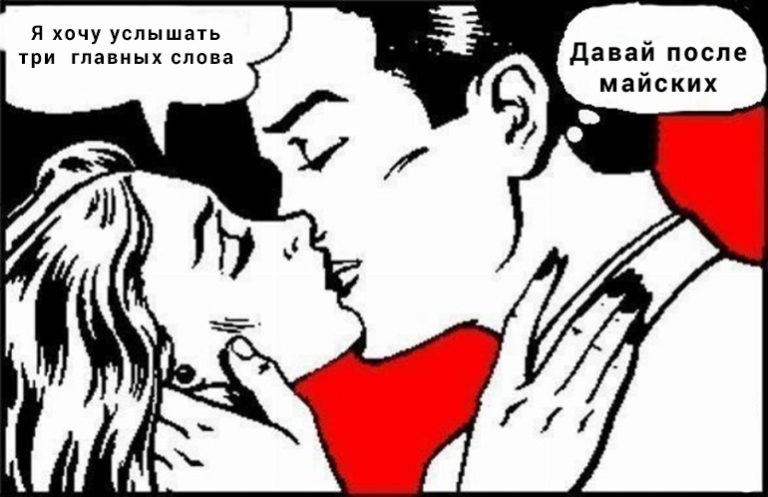
The picture is done in the spirit of old American comics: sharp black outlines, white surfaces and bright red patches on the clothing and background. On the left is the face of a woman with long hair, looking down with her eyes closed. Beside her is a man with dark hair, leaning toward her; their faces almost touch, and one hand rests under her chin.
Above the woman is a line in an ordinary speech bubble: “I want to hear the three most important words.” Above the man is a thought bubble, connected to his head by small circles, and it reads “Let’s do it after the May holidays.” So nothing is said out loud: the viewer hears what the man is thinking.
The May holidays as a universal excuse
In Russia, the May holidays are long weekends after which people are expected to return to their affairs. That is why the phrase “let’s do it after the May holidays” became a formula for postponing: people say it about renovations, negotiations, moves and any hassle in general.
The joke is double. On one hand, it is a harmless reference to the calendar; on the other, it is an admission that the person is not ready to deal with the matter. The picture makes the contrast maximal: the moment promises a confession, while the hero’s head is already planning for after the holidays.
What is known about the origin
The author of the frame and the first author of the caption are not established. The phrase itself appears in spring 2019 posts as a reply to any unpleasant suggestion, and it was called a meme at that same time. Where this particular comic came from, and who first paired it with the phrase, is not reliably documented.
So it is more honest to assume that the picture was chosen for its suitable composition, not because of any link to a specific story. The drawing itself resembles a widespread technique: take a comic with a dramatic moment and caption it with everyday text.
Caption examples
First: on the left, “I’d like to hear that we’re starting the renovation on Monday”; in the thought bubble, “Let’s do it after the May holidays.” A serious request gets a light refusal, and the wait for a decision breaks off.
Second: on the left, “Tell me the report is already ready”; in the thought bubble, “Let’s do it after the May holidays.” Here the same scheme appears in a work situation: the question sounds like a check, and the answer postpones it.
Third: on the left, “The three most important words: buy bread, take out the trash, call grandma”; in the thought bubble, “Let’s do it after the May holidays.” The comedy is built on substitution: the expected confession is replaced with household chores, and the excuse looks even more convincing.
In all three versions, the left bubble builds the expectation of an important answer, and the right one deflates it with an ordinary postponement. The pause between the lines is where the laugh is, so the captions should be kept short.
How to read the line
The phrase works as a soft excuse rather than a direct refusal. In friendly correspondence it is harmless; in a serious conversation it sounds like dodging the answer. So when captioning, consider what the matter is about: on a picture with a kiss, the joke about postponement works best.
The image is convenient to describe as a comic panel with two characters, without linking it to real people. That way the description accurately conveys what is visible, and the meaning of the phrase remains a joke about the habit of putting things off.