From an old phrase to a picture
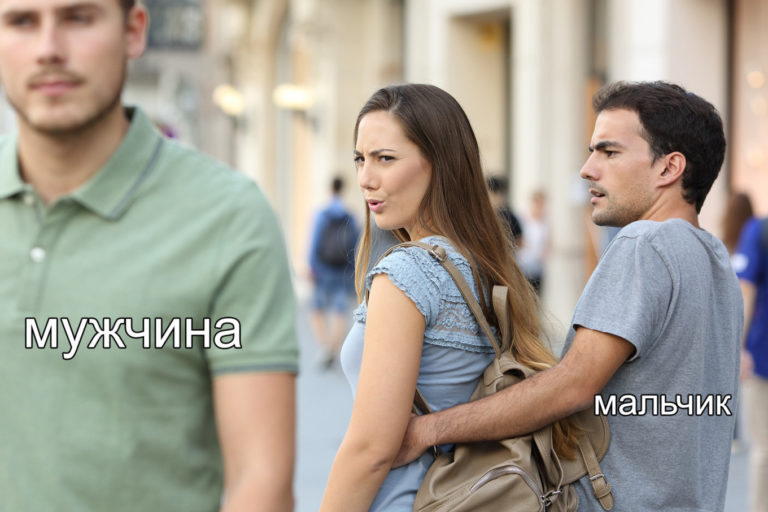
Long before this picture, the formula “boy or man” served as a short way to judge an act: one option was called immature, the other responsible. The photo line is connected to Antonio Guillem’s series and the well-known “Distracted Boyfriend” template. The classic snapshot, taken in Catalonia in 2015, shows a man turning toward a woman in red; the photographer described it as a staged situation of infidelity. Here the composition is different: a woman looks at a passerby, while her companion remains beside her. The new captions shift the emphasis once more, turning a love triangle into a comparison of two men on a conditional scale of maturity.
Roles over the photo
There are three figures in the frame. On the left, a man in a green T-shirt walks past; the woman in the center turns her head toward him, while her companion on the right holds her by the waist and watches her go. The caption “man” sits above the passerby, and “boy” above the companion. So the words divide the roles between two men rather than naming the woman or repeating the original plot one to one. The editorial joke invites us to treat the passerby as a model of adult confidence and the companion’s reaction as boyish jealousy. This is a judgment added by the captions; the photograph itself conveys nothing about the models’ characters or relationship.
Why this version argues with itself
In the classic “Distracted Boyfriend,” the man’s attention drifts from his companion to a passing woman. Here the direction is reversed: the woman looks at the man on the left, while her companion stays on the right. On top of this already altered distribution of attention comes the “man — boy” comparison, which shifts the center of the joke once more. The passerby gets the label “man” even though he barely takes part in the scene; the guy next to the woman is “boy,” because his gaze and posture seem uncertain. Thus the comparison arises from where the words are placed, not from any proven quality of the people. The captions deliberately reduce a complex situation to a contest in which one wins only because he was labeled as the model. The recognizable composition helps read this substitution at once, while the roles themselves remain a matter of dispute.
Invented captions
Invented caption: “The boy promises to help with the move and disappears after the first box; the man confirms the time and the car in advance and specifies how many boxes will be left.” Here adulthood is measured by a fulfilled agreement. Another version: “The boy buys a phone just for the color; the man picks a model that will last a long trip without a charge.” The joke is about priorities, not about a person’s worth. For a work context: “The boy writes ‘almost done’; the man attaches the file and lists what else needs checking.” In each example the words assign the roles themselves and invite the reader to doubt this scale, just as the caption on the photo does. All situations and lines are invented.