A long video about a short, pointless motion
The video “cutting water 10 hours” appeared on YouTube on April 16, 2018, on the channel “Na Minimalkakh.” The camera showed a hand with scissors and water running from a tap. The length became part of the joke: a deliberately ineffective motion was given the scale of a great ordeal. However, the ten-hour video was assembled from repeated fragments rather than representing proven continuous footage of a person during a single session.
Other users recorded short repetitions, suggested new tools, and presented the attempt as a serious experiment. At the same time, images with marks on water and scissors spread on VKontakte. In January 2019, a similar format spread on Reddit with a different photo taken from a stock photo library. This continues the general idea but is not the source of the kitchen image shown here. The metaphor proved transferable between videos, separate pictures, and new staged scenes with the same objects.
Scissors on the left, temptation under the tap
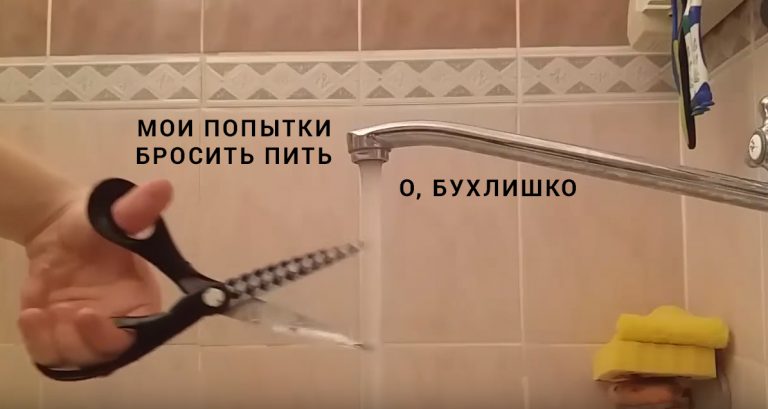
The image shows a hand holding black scissors in front of a thin stream of water. A long metal tap extends from the right; behind it are a brownish tile and a decorative strip, and a yellow sponge lies at the bottom right. The person's face is not in the frame. Above the scissors is written “my attempts to quit drinking,” and next to the water, “oh, booze.” The author of these specific captions has not been identified.
The captions turn a physical action into a small inner dialogue. The first line marks the effort and the decision made. The second sounds like a sudden recognition of a pleasant opportunity that cancels out the serious plan. The plural “attempts” matches the repeatability of the motion: the scissors can be closed again, but the stream will keep flowing. The caption does not describe what is actually in the tap. Ordinary water has been given the role of a temptation with which the hero never finishes the argument.
Why visible motion is not progress
Scissors work well on material that leaves two separate parts after cutting. A continuously flowing stream loses this result immediately. The meme shows a mismatch between the tool and the nature of the problem: the action looks decisive but does not change what keeps the flow going. That is why the picture differs from a simple image of a lazy person. The hero is busy, spends time, and may even repeat the motion diligently.
In captions, the scissors usually stand for a ban, a weak objection, or an attempt to stop a habit. The water stands for a flow of events, messages, or desires. The comic hopelessness comes from their meeting: the marks promise a struggle, while the image shows in advance how that struggle repeatedly ends. The drinking version adds self-irony. A short, cheerful remark on the water's side sounds more convincing than a long promise on the tool's side.
Flows that never end
An invented office version labels the scissors “cleared all the emails” and the water “another reply to everyone.” Each successfully closed email is immediately replaced by a new one. Here the hero really is working, but the image conveys the sense that the queue has no end.
In another invented picture, the scissors are a request from members of a gaming group for a quiet evening, and the water is messages from a friend who has found yet another funny video. A third variant compares an attempt to free up phone storage with the habit of photographing every detail of a walk. It is especially suited to self-irony: the source of the flow sits with the owner of the scissors. The examples differ in their reasons but keep the exact structure of the scene. The hero removes one manifestation while new ones keep arriving through the same channel.