A flash mob that started with photos
In early 2019 a flash mob spread across Facebook, Instagram and Twitter under the hashtag #10YearChallenge, and in another version #2009vs2019. Participants posted a photo from ten years earlier alongside a current one, often with a short caption. Both celebrities and ordinary users took part.
The exact start date and the author of the hashtag remain unknown; it is only known that the wave came in early January 2019 and quickly moved from one network to another. Later reposts should not be taken for the first wave.
Comparison as a format
The flash mob itself was about personal photos, but the meme grew out of a scheme: two frames, one showing the past, the second the present. The scheme fits any topic with a “before” and an “after”: gadgets, fashion, favorite games, cities, even arguments in a chat.
This format is good because almost no explanation is needed. A pair of pictures with a hashtag is understood at once, and the joke arises from what exactly is chosen for comparison: the viewer completes the contrast in their own head and recognizes their own experience in it.
The facial recognition theory
A theory arose around the flash mob that Facebook had organized it to train facial recognition software. It was reported that the company denied this. The theory is not confirmed, and it should be presented as a supposition, not as a fact.
The rumor matters for understanding the era: people caught themselves sharing personal photos and began to argue about who would benefit from it. The meme itself does not have to agree with the theory; it uses only the frame of comparison.
Captions in the “then and now” format
Below are examples invented for this template.
“2009: I thought life was a movie. 2019: I realize it's a series.” The contrast between the expectations and the experience of one and the same person. The word “series” works as a twist within the same comparison format.
“2009: the question was where to buy a disc. 2019: the question is where to buy a subscription.” The example shows how the comparison works on technology: the object changes, not the person, and recognizability comes from a domestic detail.
“2009: I text the chat that I'll be there soon. 2019: I text the chat that I'm already home.” This short pair shows how an everyday example makes the comparison come alive; the delay between the two lines is what creates the effect.
All the captions work on one scheme: the first part sets an expectation, the second cancels it. The shorter the second part, the stronger the reversal of expectation.
What the picture says
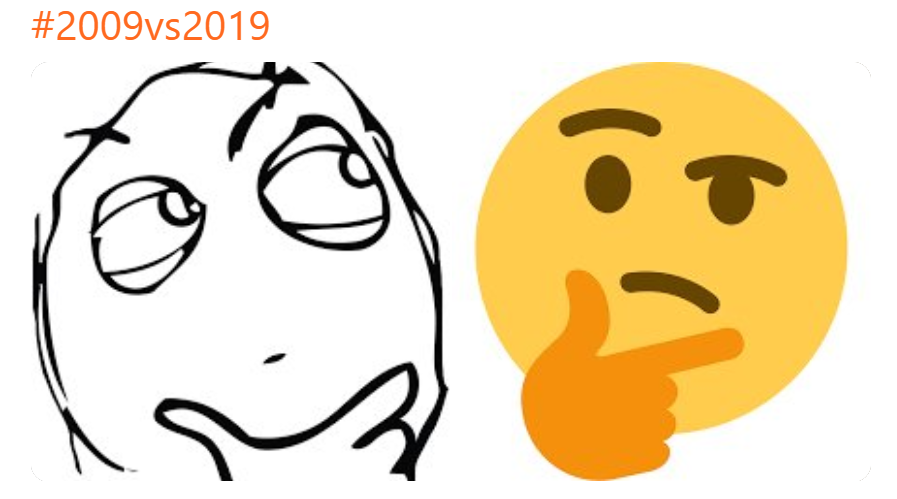
The frame has two images side by side. On the left is a black-and-white face in the style of rage comics: a pensive grimace with raised eyes and a small mouth, typical of internet humor of the late 2000s. On the right is a yellow “thinking” emoji with a hand at its chin, a familiar sign of the 2010s. Above them is the orange hashtag #2009vs2019.
The pair shows that both images express the same thought, “hmm, something's off here,” but by different means: a drawn grimace of the past and a modern icon. This is a comparison of eras in miniature. A caption for such a frame can be built on the idea that internet language changes while the habit of doubting stays the same.