What’s in the picture
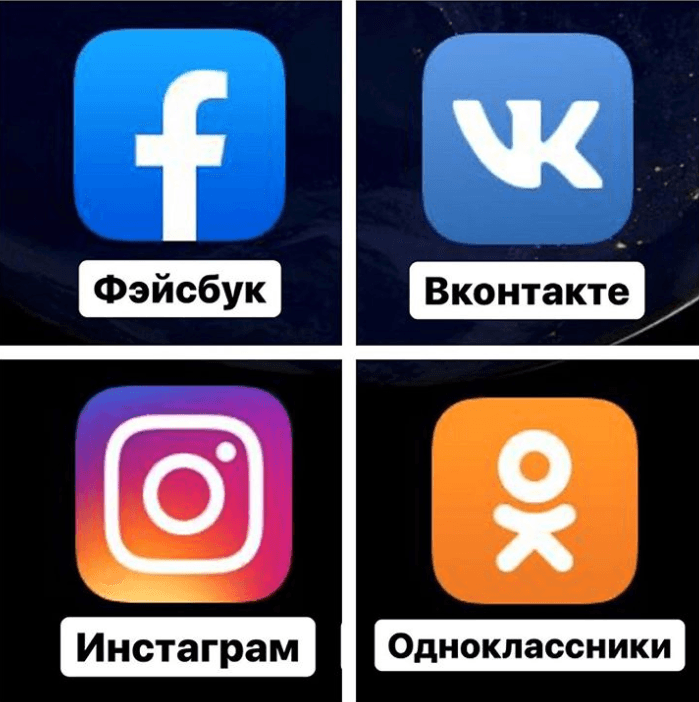
The square is divided by white lines into four cells. The top row has the Facebook icon (a white “f” on blue) and the VKontakte icon (white “VK” on light blue); the bottom row has a multicolored Instagram icon and an orange Odnoklassniki icon with a white figure. Under each icon is a white label with the name in Russian: “Фэйсбук” (Facebook), “Вконтакте” (VKontakte), “Инстаграм” (Instagram), “Одноклассники” (Odnoklassniki). The background is dark, with patches of light resembling a view of a planet from space.
This is not a finished joke but an empty frame: the author inserts photos in place of the icons. The network lineup here is Russian-language; the original challenge used other platforms, discussed below.
How Dolly Parton started the trend
In January 2020, shortly after her 74th birthday, American singer Dolly Parton posted a collage of four photos. The first, in a blazer, was labeled LinkedIn; the second, in a Christmas sweater, Facebook; the third, a black-and-white official portrait, Instagram; and the fourth, in a bunny costume, Tinder. She added the phrase “Get you a woman who can do it all” to the collage, roughly “Find yourself a woman who can do everything.”
The post spread quickly. According to American media, versions were posted by TV hosts Ellen DeGeneres and Jennifer Garner, anchor Julie Chen, as well as ordinary users, fan accounts, pets and brands. So within a couple of days the collage had acquired a name: the Dolly Parton Challenge.
Why the format worked
The joke rests on stereotypes about each platform. LinkedIn is a career showcase where everyone wears blazers. Facebook is the family circle: holidays, relatives, sweaters. Instagram is the polished picture. Tinder is the place where a person tries to look attractive, sometimes deliberately funny. Readers instantly recognize these roles, so nothing needs explaining.
A second plus is the low barrier to entry. You don’t need to come up with text: it is enough to pick four shots from your gallery. Hyperbole also works: the more the frames differ, the funnier it is. The Russian-language variants simply replaced some platforms with ones familiar to the local audience, as in this template.
Caption examples
Invented variants for a Russian-language grid: on Facebook, a photo from a family dinner; on VKontakte, a snapshot from a party ten years ago; on Instagram, a shot against a sunset; on Odnoklassniki, a postcard with a kitten and roses. It is funny because each cell shows the “correct” style of that network.
A joke about work: on Facebook, “a person who values work-life balance”; on VKontakte, “a person who watches memes instead of writing the report”; on Instagram, “a person whose life is perfect”; on Odnoklassniki, “a person who accidentally liked a photo from twenty years ago.” Here the contrast between the declared life and the real one does the work.
A version for a pet: four photos of a cat. On Facebook he is serious, on Instagram he shows off, on VKontakte he sleeps, and on Odnoklassniki he sits on the windowsill next to a geranium. There is nothing human in the frame, but the format still reads.
How to build your own version
Pick photos with different moods: businesslike, homey, posed and openly unserious. The more contrasting the frames, the better. It is best to leave the labels in the cells as they are: the network’s name is the entire caption.
Swap the platforms for your own audience. If your readers are on other networks, use those. The main thing is that each network has a recognizable image, otherwise the joke won’t land. And remember: it is more fitting to laugh at yourself than at other people’s photos used without permission.