Format of the joke
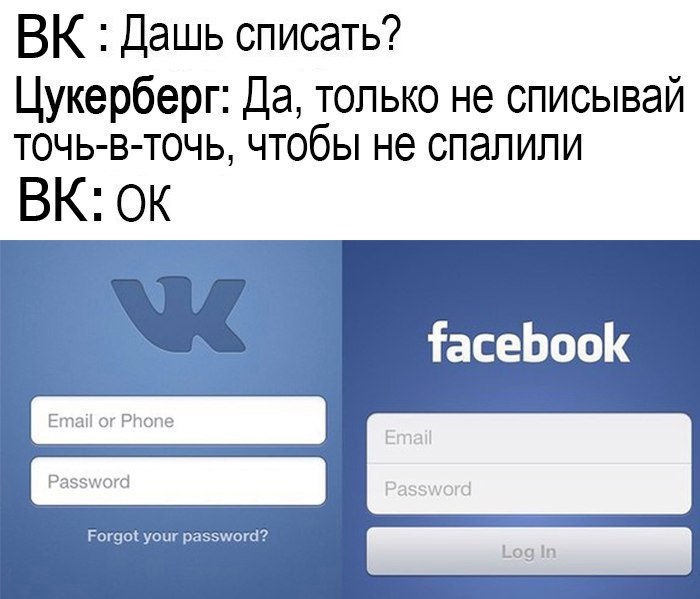
The meme is built on a dialogue set in a school context. One character asks to copy homework, and the other agrees on the condition that the copy won't be exact. In this way an ordinary school situation turns into a hint at imitation. At the bottom of the image are two similar screens, and the viewer is invited to compare them: the resemblance is obvious, but formally no one admits to copying.
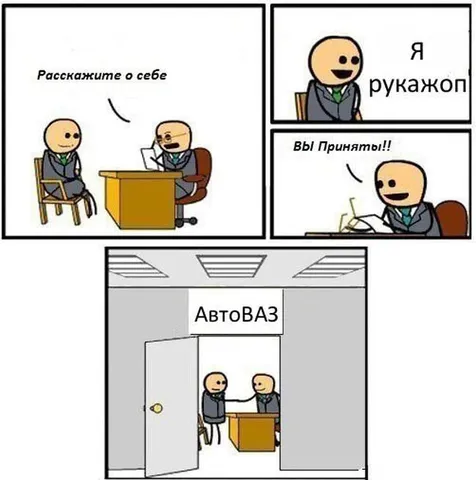
The construction itself is flexible. Instead of students and notebooks, any similar objects can be substituted, and the joke keeps its meaning: there is a resemblance, but no one openly admits to it.
What is shown
In the version from the post, the lines at the top read as follows: VK asks to copy, Zuckerberg replies that it's fine, just not exactly, so as not to get caught, and VK agrees. Below are shown the login screens of two social networks. On the left is the blue VKontakte interface, with fields for email or phone and password, and a password-recovery link. On the right is a Facebook screen with a similarly structured set of fields and a login button.
The meme points out that the placement of elements, the color scheme, and the shape of the buttons are similar in both cases. It's exactly this visual resemblance that becomes the object of the joke, and the lines of dialogue simply give it the shape of a conversation.
Historical context
VKontakte launched in 2006 and in its early years was often compared to Facebook: profiles, walls, messages, and the general logic of the service were recognizably similar to the American social network. The topic of copying design and features came up regularly in the Russian-language internet, so the meme quickly struck a chord.
The exact author of the image and the date of its first publication are not known. This version dates to 2017, when the image spread in communities devoted to internet humor and social networks.
Mechanics of the humor
The main device is an absurd arrangement. Zuckerberg supposedly calmly allows the copying, but on the condition that the copy not be too similar. This move turns an accusation of copying into a polite joke between rivals. The viewer understands that "so as not to get caught" means covert imitation, and the resemblance of the screens confirms the ironic subtext.
A public figure here serves as a meme character, and the joke concerns companies and their products rather than the person's personal qualities. This is a typical example of humor about corporate competition, where the characters merely personify the services.
Significance
The meme fits into the tradition of jokes about clones and copied interfaces in the tech industry. Similar scenarios cropped up around services from different countries, and users often compared login screens, buttons, and icons, hunting for matches.
Today the image survives as a reminder of the social-network rivalry of the 2010s and of how visual resemblance turned into a subject for mockery. It's easy to understand without knowing the details of either service's history, which is why it remains clear even years later.