Origin of the comic
Cyanide and Happiness is a webcomic created in 2005 by a group of authors that includes Kris Wilson and Rob DenBleyker. The series came out as short sketches full of dark humor, and its characters often end up in situations where logic breaks down for the sake of a joke. The authors placed the interview story within this style, and it quickly became one of the series' most recognizable episodes.
The frames about the interview form a fairly self-contained series on their own: an applicant sits across from an employer, the employer asks him to tell about himself, and the answers get more and more absurd. According to records, the series began living a life of its own separate from the main comic around 2009. The exact first publication of this particular storyline has not been conclusively established in open sources, so we rely on the series' general history and the spread of the images.
The Russian adaptation
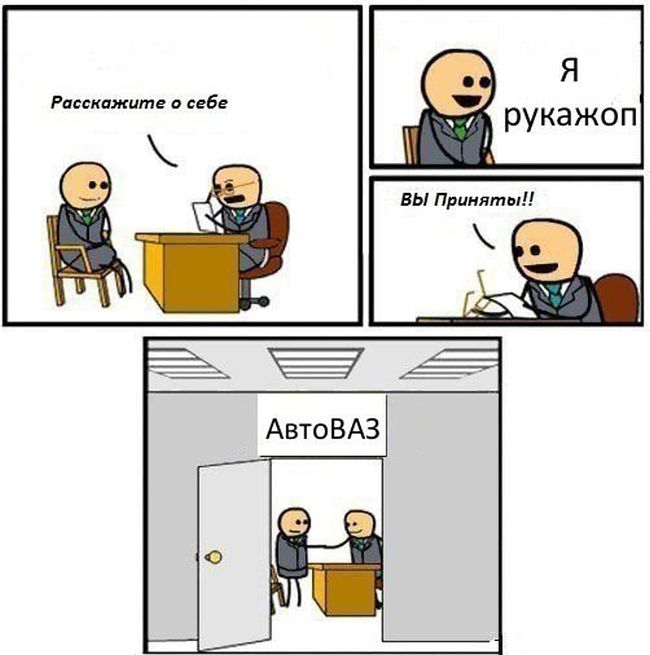
The Russian version keeps the structure of the original but changes the final line. The applicant answers "I'm a klutz [rukozhop]" — that is, he admits to being completely incapable of working with his hands — and the employer happily says, "You're hired!" The word "rukozhop" is a crude, colloquial, and ironic term for someone who does everything clumsily and without skill.
The final frame, where the employer and the applicant shake hands in an office with a sign reading "AvtoVAZ," adds a link to a real company. The joke is built on the stereotype of unskilled labor at a large manufacturing plant. Mentioning a real enterprise makes the joke local, but it isn't aimed at specific people — it targets the general situation of being hired.
Why the format caught on
A job interview is a situation everyone understands, so the picture transfers easily to any field. Users changed the captions, swapping in the names of companies, schools, and professions, and each time the joke was built on the mismatch between the polite question and the blunt answer.
In the Russian-speaking space the series became a local template for jokes about employment and about stereotypes surrounding technical professions. The picture is convenient because it can be assembled from three frames and one logo, which is why many homemade versions appeared quickly. Similar storylines about rejecting an interview or giving answers along the lines of "I can't do anything" also appeared in other comics, so the joke draws on a long-familiar device.
Assessment and limitations
The meme isn't tied to a specific person and doesn't depict a real interview, so it's usually seen as genre satire on the labor market. The self-deprecation in the answer works as a plot device, not as a call to mock anyone.
Information about the exact date the Russian version appeared and about who came up with it is not confirmed in open sources, so the text describes the general outlines of the story without specifying authorship.
Comparing the versions, one can note that the Russian variant is noticeably harsher than the original: admitting to being unable to work with one's hands sounds like self-deprecation rather than an ironic refusal of the position. Such a shift in tone is typical of many local adaptations, where the joke leans on recognizable images of manufacturing work.
The series itself remains an example of how a short comic can live on separately from its original source and accumulate its own captions, versions, and references.