A night fear turns out to be a family quarrel
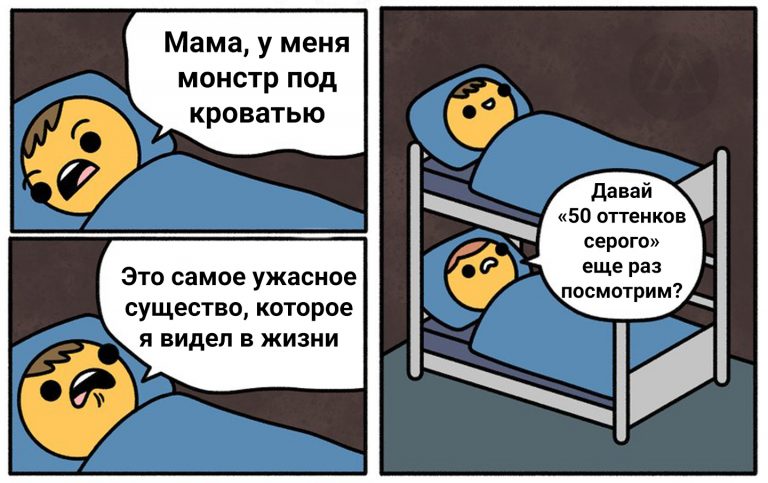
Chris McCoy drew this story for the Safely Endangered series. The installment Monster, number 331, appeared on WEBTOON in March 2018. The hero calls his mother and complains about a monster under the bed, adding that he has never seen anything more terrifying. The final wide shot reveals the layout of the room: the bed is a bunk bed, and his brother lies below. The brother does not scare or threaten; sounding hurt, he asks why he is so disliked.
The original joke depends on a change of scale. In close-ups the reader imagines an unknown creature somewhere in the dark; the general view turns it into a close person. In the same March the drawing spread through Twitter and Reddit, and then Russian translations and replacements of the final line appeared. In the remakes, the lower character already gives cause for complaint himself. The author of the specific Russian text about the film has not been established, while the drawing remains McCoy’s work.
Two complaints on the left, the answer on the right
In this version the three panels are not arranged in one horizontal row. On the left, close-ups of the yellow-faced hero under a blue blanket are stacked one above the other: he calls his mother and calls the neighbor the most terrifying creature. The large right panel shows both tiers of the metal bed at once. The lower little figure suggests watching “Fifty Shades of Grey” once more. No one turns into a real monster: the word “monster” expresses an attitude toward a repeat movie night. The mother remains outside the drawing and does not answer.
The last line changes the shape of the accusation
The usual story about a night monster demands a check: who is hiding under the bed? Here the answer is a phrase, not the creature’s appearance. The lower hero looks almost the same as the upper one. For the joke, it is enough that he is about to propose again an activity the roommate is already tired of. The enormous complaint prepares a strong reason in advance, and the mundane suggestion is comically out of proportion with its scale.
Because of this, one and the same drawing allows different relations between the heroes. One can sympathize with the upper one if the suggestion seems intrusive, or laugh at his excessive reaction to a harmless taste. The line from below determines whom the irony falls on. In the author’s original the brother has a reason to be offended; in the remake about rewatching, he seemingly confirms the neighbor’s complaint without even realizing what frightening thing he has said.
What another neighbor might offer
In an invented version, the lower hero offers to retell the ending of a detective novel before the neighbor starts reading. The upper one calls his mother in advance, as if he had run into a night threat. The horror turns out to be not danger but an overly active helper: he is ready to deprive his brother of the pleasure of discovering the resolution himself. The wide shot reveals that the source of anxiety lies very close and smiles in a friendly way.
A second invented line goes: “Let’s go through the tutorial again, in case you forgot how to jump.” The heroes were going to play, but the lower neighbor again chooses the simplest introductory part. The complaint about the monster exaggerates the fatigue from repetition. For a knowing player, one familiar button is enough: the night promises to pass in explaining an action that has long been mastered.
A third invented neighbor wants to set a second alarm clock in the room a minute before the first, so that the first one does not catch them off guard. Pointless foresight makes him a source of future noise. The bed keeps the literal position “under me,” while the new phrase explains the emotional meaning of this neighborhood: the upper hero is already imagining a morning he very much does not want to wait for.