Hannah Hillam’s comic and its follow-ups
Hannah Hillam drew a dialogue between a person and their own brain for a BuzzFeed roundup published on June 12, 2017. In the original version, the question about sleep was followed by an anxious thought about a possible danger, and the heroine immediately woke up. Later, users started changing the brain’s line while keeping the recognizable structure: a person wants to sleep, the inner voice asks a seemingly unrelated question, and sleep is pushed away. Online copies and translations diverge noticeably from the author’s drawing, so the specific Russian version should be read as an adaptation rather than a literal copy of Hillam’s original.
Hillam’s post appeared in the roundup “15 Conversations You Have with Your Brain”; it includes various short scenes of inner dialogue, but the pre-sleep episode turned out to be convenient for reworking. In 2018, people on Reddit were already changing the brain’s line and keeping the rest of the structure. This distinction is useful: first there was an authorial comic with a specific ending, then a portable template, and the Russian picture uses it, replacing the original premise with its own paradox.
What happens in this version
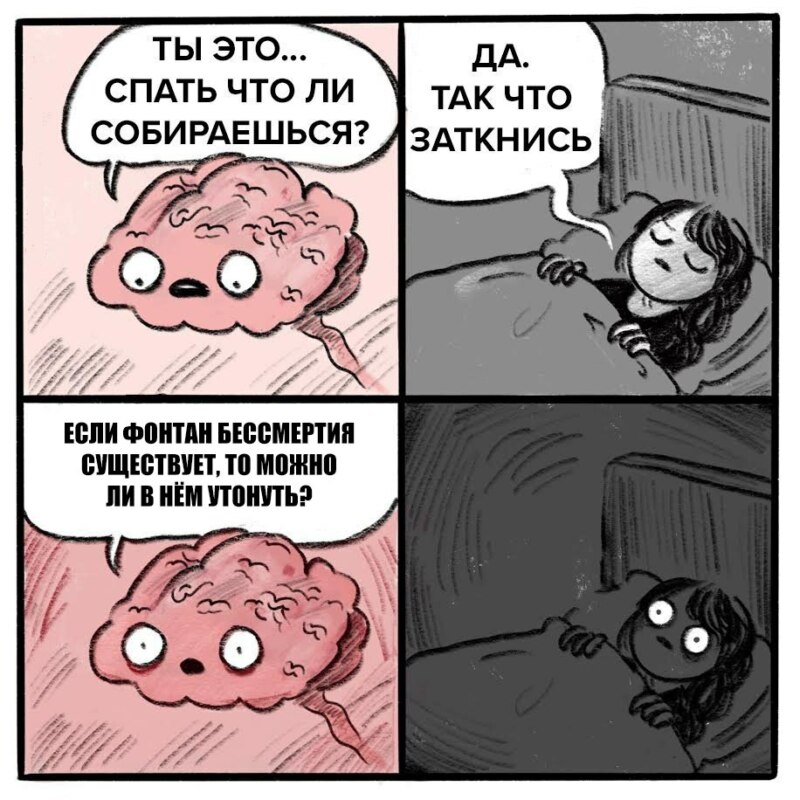
In the first panel, the brain asks whether the girl is going to sleep; she answers sharply and asks it to be quiet. Then the question comes: if a fountain of immortality exists, can you drown in it? The last panel is almost entirely plunged into darkness: the bed and the wide-open eyes are visible. There is no long monologue here and no answer to the riddle — one absurdly serious question is enough to switch the scene from an ordinary evening to being awake among thoughts.
The transition between panels also changes the tone. At the start the question sounds almost caring; then the girl’s answer abruptly cuts off the conversation, and the brain immediately returns with a new topic. The last dark panel doesn’t show what happens next: it is a visual sign that the night has already begun and the heroine still isn’t asleep. This ending lets the scene be read both as a tired joke and as an admission that the brain can spring a riddle on you right after the command to “stop thinking.”
Why the brain chooses this exact moment comically
The brain character turns the inner monologue into a conversation partner who ignores the obvious request: right now what’s needed is silence. The contrast is amplified by the girl’s short reply, the absurd logic puzzle, and the abrupt change in lighting. The humor here comes from a familiar situation: as soon as you lie down, a question pops into your head that hasn’t bothered you all day. In an invented continuation, instead of the fountain there could be an argument about whether soup counts as a drink, or an attempt to remember the title of a film that nobody needed until this evening.
Invented continuations
For example, the brain asks: “If you set an alarm for seven and wake up at six, will it still go off?” The heroine answers “sleep,” and in the next panel she is already mentally comparing bus timetables. Another imagined variant: “Are you asleep? Then remember whether you sent the email to your professor.” What’s funny here isn’t the anxious topic itself but its suddenness: the question appears after the conversation should already have ended. These examples were made up to explain the construction and are not a continuation of Hillam’s comic.