Chris Wilson's original joke
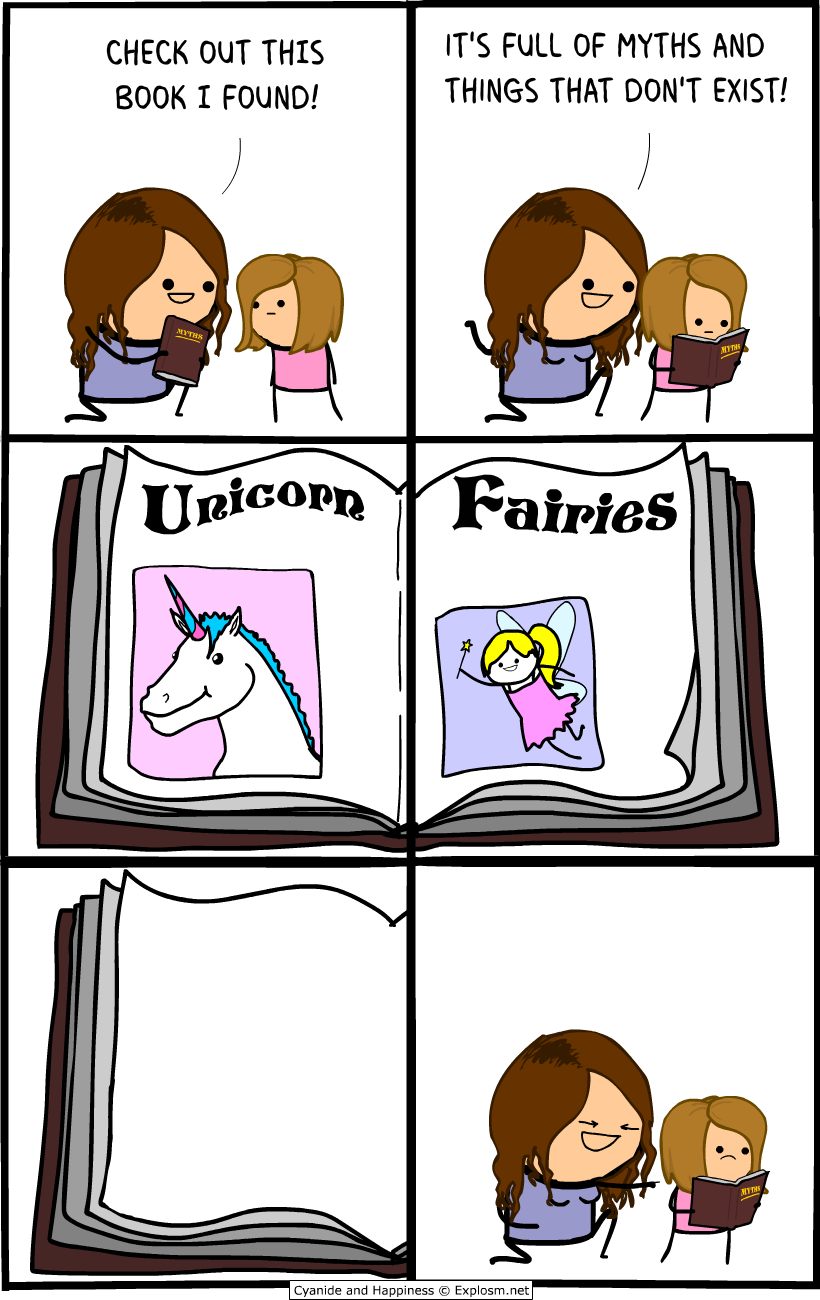
Chris Wilson's original comic was published on November 15, 2017. The mother offers to look at the book they've found and explains that it collects myths and things that don't exist. After the fantastical creatures, the book presents an unexpected entry: “Your Boyfriend.” A reference guide to the fantastic turns into a personal joke aimed at the daughter.
In the editable version this entry was removed, but the rest of the scene was kept. This matters: from the source, not only the book and the invitation to look at it remained, but also the characters' reactions. In the last panel the girl frowns, and the mother laughs with her eyes closed. So the blank page doesn't cancel the mocking ending; it leaves room for a new reason.
How the three rows of the image work
In the top row the mother holds the book and speaks to her daughter; then the book ends up with the girl. The viewer first sees the object from the outside, then reads it together with the character. The shift from conversation to a close-up turns an ordinary find into a promise to show something amusing.
The middle row is a book spread: a unicorn on the left page, a fairy on the right. Two familiar fairy-tale creatures set the rule of classification. Bottom left shows the next blank page, bottom right the reaction of the mother and daughter. The reading order already leads to the punchline: the viewer sees the new entry before they explain the girl's displeasure to themselves.
The reference book as a personal jab
The comedy comes from the collision of an impersonal reference-book tone with a domestic conversation. The book seems to simply list invented things, while the mother uses it as confirmation of her joke. She doesn't argue with her daughter directly: the statement takes the form of a ready-made reference entry next to the unicorn and the fairy.
A new caption might concern a promise, a habit, or an inflated expectation. The characters' facial expressions set the relationship between them: one knows where the showing will lead, the other becomes the target of an unexpected remark. If you insert only a neutral object, the book stays understandable, but the girl's displeasure becomes harder to connect with the content of the page.
Invented entries for the blank page
“Your ‘five minutes’ before leaving the house.” This invented entry lets you read the scene as a familiar conversation before a walk: the promised short wait lands in the section of the impossible. The mother knows in advance how long the waiting will last, and the daughter recognizes her own habit in the book's joke.
Another invented variant is “Monday, when you start running.” Here, every start that keeps getting postponed becomes the fantastic. The mockery is aimed not at the running itself but at the calendar promise that keeps getting moved. The spread with the unicorn and the fairy sets up the comparison, and the final faces turn the abstract entry into a small family scene.