David T. Michaels’s comic
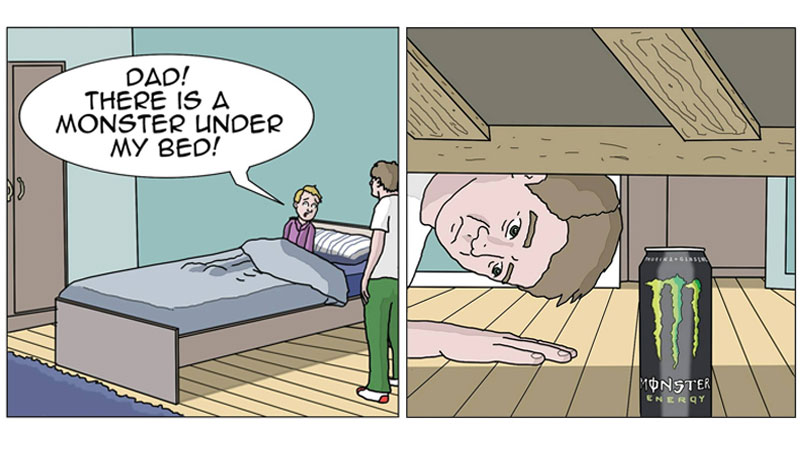
The original comic is attributed to the artist David T. Michaels and dates to 2017. In the first panel the boy calls his father and says there is a monster under the bed; in the second the father bends toward the floor, and beside him is a can of Monster Energy. The frightening word “monster” gets a mundane, literal reading: instead of a creature, the child noticed a drink with that name.
That same year remakes appeared: dated chronicles note a collection on Imgur in July and a variant with Team Fortress 2 characters on Reddit in August. These records show early spread, but they do not prove that no other copies existed before. This two-panel version keeps the simple scene without additional characters or text over the drawing.
Two panels and a change of scale
The first panel shows the whole room: the bed, the child, and the father who comes when called. In the second, the gaze literally drops under the bed; there, next to the father’s face, stands the can. Such a change of scale leads the reader from an alarming story to a concrete discovery. The tension is brief: the viewer is already waiting for a monster, but the composition quickly points to an object that explains the line in a different way.
The order of the panels also shifts the point of view: first the father stands by the bed listening to the child, then the reader finds themselves at floor level beside him. The black can stands out against the light floor, and the green sign is recognized before the lettering can be read. The move from room to close-up makes the final detail the center of the frame.
How users reworked the discovery
The first known remakes changed not only what lies under the bed but also who takes part in the scene: for example, in the Team Fortress 2 variant the original characters are replaced by the game’s characters. So a domestic fright turns into a fan sketch. In invented versions the father might find a spare alarm clock under the bed that the child hid before a school morning, or a shoebox mistaken in the dark for an unknown creature.
In both examples the object explains why the child raised the alarm, but it creates a different mini-story. For the alarm clock version, what matters is who hid it; for the shoes, that in the dimness an ordinary shape looks frightening. So the source of the discovery changes, while the two-panel rhythm remains recognizable.
Why the pun looks different in Russian
The original joke uses an English coincidence: “monster” is both a word for a creature and part of the drink’s name. In Russian, the translation “monster under the bed” does not literally match the Monster Energy label, so the reader is helped by the logo and the English word on the can. The translation of the caption still preserves the child’s expectation, while the image brings the reader back to the product name.
If the packaging were replaced with an unnamed can, the viewer would have to guess the connection; if the brand is kept, the pun reads across two languages. One could also invent a Russian version with an object whose name has a second meaning, but then the twist would be new rather than an exact translation of the original comic. This explains why the familiar picture often keeps its original lettering.