What is happening in the frame
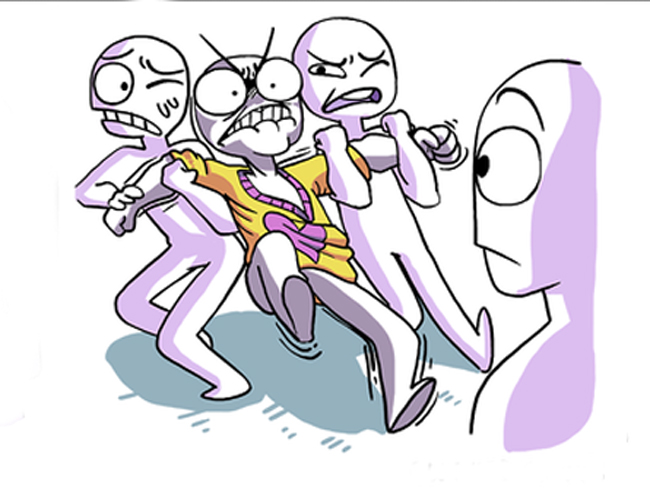
The drawing shows several light figures with purple fill and thin black outlines. In the center is a man in a yellow shirt with a purple bow on his chest: his teeth are clenched, his eyes bulge, his brows are furrowed, his feet are lifting off the floor, and a blue smear of shadow is visible beneath them. Two people hold him from either side: one has grabbed his arm, the other has a face contorted with effort, and a raised fist is right beside him.
On the right stands another figure who is not part of the scuffle. Their face is almost blank, their eyes are wide open, and they are watching the scene with clear bewilderment. This gaze sets the viewer's position: they see the fight from the outside and do not know how it started.
What is known about the origin
The meme's name links the image to a hippie, that is, a person of peaceful views who suddenly throws a punch. It is mentioned that the drawing may be part of a comic, but neither the author, the original source, nor a date of first appearance in known materials has been confirmed. From a single frame it is impossible to tell which moment of a story it shows: no poster, no arguer, and no other participants are visible.
For that reason, it is better not to treat the picture as a standalone template with an unclear origin. Establishing authorship would require finding the original series of drawings, not retellings in communities.
How the joke works
The main engine of the meme is broken expectation. The caption usually describes an innocent beginning, and the frame turns out to be its unexpected consequence. The calmer the stated position, the stronger the laugh at the sudden brawl.
The drawing style helps too. The figures are simplified, the faces are grotesque, and no punch lands: the fist is raised, but nothing happens. The scene therefore reads as comic chaos rather than violence, and the viewer laughs at the disproportion of the reaction, not at the violence itself.
Example captions
Four invented captions are below.
“I just asked why there is no music in the park.” The question sounds harmless, and the answer turns out to be physical.
“We agreed to discuss it, not to hug.” The word “hug” mocks what is happening.
“We picked a restaurant for the evening, and it ended in a fight over the last chair.” A mundane reason contrasts with the scale of the scene.
“When you're calm, but the conversation has turned to the right kind of pizza.” This short formula explains the mechanics: the calm holds until the first sharp word.
In every version, the pause between the line and the outcome matters: if the caption simply describes the brawl, the joke disappears.
How to use the template
The frame suits stories where a person with gentle views suddenly loses their composure over something trivial: an argument about the menu, the route, or which movie to watch. The caption should be as exaggerated as the drawing.
Do not tie it to real groups of people or real conflicts: the drawing is meant as an abstraction, and any attempt to attribute it to a real event turns the joke into an attack. It is safer to invent your own small situations in which no real person is harmed. The reverse trick also works well: write a caption about the observer on the right, who asks with wide eyes how they got into this in the first place.