From webcomic to universal template
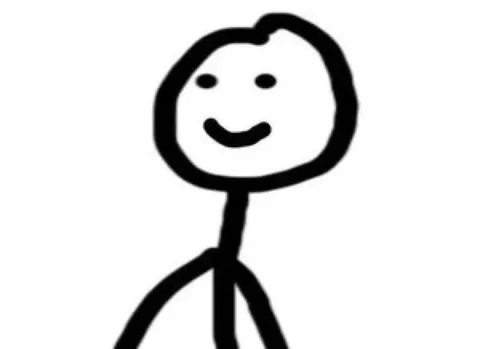
The name Flork of Cows is tied to a webcomic that its author publishes in a deliberately simple style, including using MS Paint. Early strips and today's meme images don't always match: characters get redrawn, text changes, and new compositions get created. Belonging to the familiar style still doesn't prove that a particular local drawing was made by the original comic's author.
What spread widely were simple figures with round heads and thin limbs. They're easy to reproduce across several panels to show a dialogue, a reaction, or the development of one situation. Unlike a detailed illustration, the uneven MS-Paint-style lines leave the viewer more room for their own context, and the drawing's recognizable crudeness itself becomes part of the joke.
Minimal detail, maximum tone
The character is shown large against a white background: a black outline, small eyes, and a wide smile. Crossed arms can be read as confidence, waiting, or deliberate calm, but the meaning shifts with the text. The drawing doesn't need realistic facial expressions — a few simple details are enough to signal a mood.
Flork helps turn an inner monologue into a one- or multi-panel comic. The character can be dressed in a uniform, given a sign, a phone, or a cup; this creates a protagonist for a specific situation without any complex design. What matters isn't just the figure itself, but the mismatch between its simple appearance and a confident line or an overly dramatic role.
Scenes you can draw yourself
First panel: "I'm definitely finishing all my tasks today." In the second, Flork sees a list of thirty items and says: "First I'll pick a color for the heading." The joke is built on swapping actual work for preparation. For a family chat, you could draw him with keys: "I'm heading out now," then show the character still looking for the second shoe.
For a group of friends, a mini-dialogue works well: "Who brought the board game?" — "I brought the rules, the box stayed home." The simple pose makes the explanation stand out without adding distracting detail. These are new examples; they aren't quotes from any specific strip of the webcomic.
Making variations without false attribution
The template is handy for homemade comics, reactions, and quick explanations when you need a two-step sequence. For your own version, you can note that it's made "in the style of Flork" if the origin of the original file is unknown. Resemblance in technique doesn't prove authorship of a specific drawing.
Match the line to the position of the hands and the facial expression, but don't treat any one gesture as a universal symbol. Crossed arms can show patience, smugness, or just the character's pose — the text sets the reading. The picture stays recognizable precisely because it doesn't explain the whole plot on behalf of the caption's author.
The simplest figure is especially handy for a sequence of cards: the first shows an intention, the second an obstacle, the third a reaction. For example: "Going to bed early tonight"; "one more short video"; "why is it already morning." The drawing doesn't need to be technically neat: repeated poses and short text create the expressiveness. But when publishing a derivative drawing, don't attribute a specific panel or character to the author without confirming the origin of that particular picture.
You can draw literally three lines and one expressive pose, as long as the sequence is clear. For the reader, a clean shift between expectation and outcome matters more than an elaborate background or detailed expression.