A smirk as a ready-made line
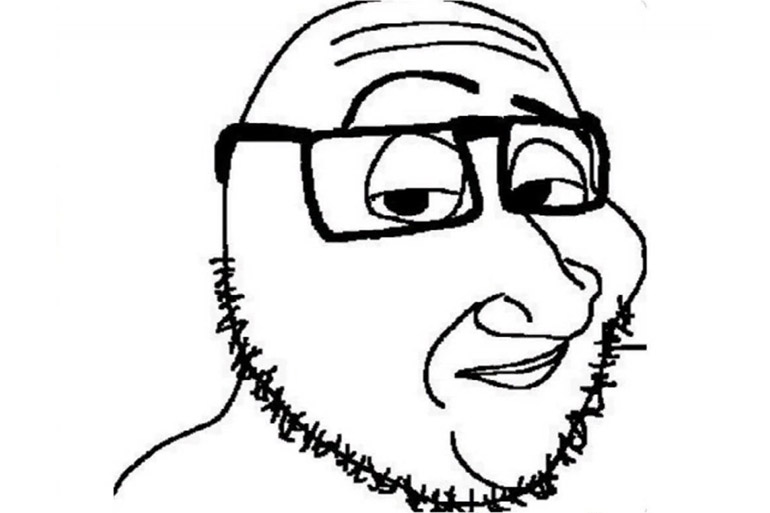
Two elements matter at once in this template: a face with a confident smirk and a short phrase claiming that others supposedly can't understand something special. The character doesn't explain the thought or offer proof. He essentially declares himself in the know in advance, and the readers as not sufficiently prepared. Because of this, the image works both as praise for one's own taste and as a parody of that very kind of praise.
In the Russian-language version, the phrasing "Shame not everyone will get it" (literally "Pity that far from everyone will understand") became established. Sometimes it's shortened to "not everyone will get it" or adapted to a specific topic. The drawing is recognizable even without the caption, but it's the text that reveals the tone: not genuine regret, but ostentatious mysteriousness. Importantly, this line isn't a confirmed quote from a real person: it's a meme caption attached to the character.
From Smugjak to the Russian Smagdzhek
The English name Smugjak combines the word "smug" with an ending common for drawn faces from internet forum culture. In widely shared versions, the image is linked to Hal from the animated film "Megamind": the recognizable glasses, beard, and smirk resemble the character, though specific redraws differ. So it's more correct to speak of a derivative internet image rather than attribute every copy to one artist.
In early 2023, the template spread in English-language communities and then became noticeable in Russian posts with the translated phrase. With each repost, details of the face, format, and text changed. Such a chain is typical for memes based on a simple drawing: the authorship of the early version can be hard to establish, while the meaning quickly separates from the original platform and starts living in new contexts.
What the meme actually mocks
On the first reading, the character portrays a snob who enjoys feeling smarter than everyone else. He doesn't share knowledge but uses it as a reason to create distance. The second reading is more good-natured: a person is simply delighted by a rare reference that few people share. Context is what distinguishes these readings. If there's a relatable everyday example nearby, the phrase sounds self-deprecating; if the author is seriously setting themselves apart from "the masses," the meme can come across as arrogant.
The smirk works best exactly where there's a specific jargon at play — old games, a niche music genre, local jokes, or complex hobbies, where the viewer either instantly catches the reference or plainly doesn't. However, it doesn't prove that the topic is genuinely rare or complex. The comic effect is built on an exaggerated claim. Often the viewer gets the joke precisely because they know the subject themselves, which disproves the phrase about not being understood.
Examples of new captions
"When friends finally ask why I keep a box of old cables, and it turns out to contain exactly the one adapter that can't be found anywhere else." Here the character takes pride not in secret knowledge but in everyday foresight. The caption turns the mysterious pose into a relatable moment of self-deprecation.
"Explaining why a board game has three versions of the rules, and noticing everyone has already opened a different game." This version plays on a real difference in interests without claiming board-game fans are better than everyone else. The more specific the subject of the joke, the easier it is for the audience to read it as exaggeration.
You can also drop the meme after an unexpected reference comes up in conversation: "Finally, a person who also remembers this jingle." In that case, "not everyone will get it" becomes a friendly signal of recognition rather than a way to put down people who aren't in on it.
How not to turn the joke into arrogance
If the caption is aimed at the author themselves, the meme usually reads softer: they're laughing at their own tendency to overcomplicate simple things. If the target is a specific group of people, the phrase can sound like outright contempt. It helps to check whether the joke can be understood without assuming that one audience is "above" another.
The current caption shouldn't be passed off as a line from the animated film or as the words of the drawing's actual creator. The template has many redraws and translations, and the exact history of a given copy often can't be reconstructed. It's more reliable to describe the meme's known form and its use, while noting the limits of what the image itself actually shows.