What is shown in the picture
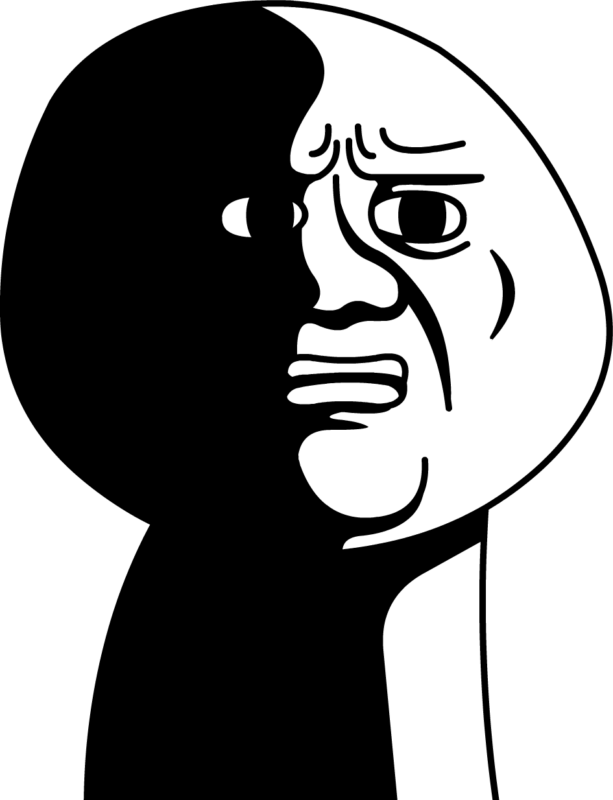
The image shows a head drawn in black-and-white graphics with simple outlines. The left half of the face is completely filled in black, leaving only the right eye and part of the cheek light. The right eye is wide open, the eyebrow is furrowed, and the mouth is twisted into a grimace. The expression is anxious and bewildered, as if the character has just heard something incredibly absurd and can't quite believe what's happening.
The drawing belongs to the rage faces style — a set of standard faces created for quick comics. Characters like this were drawn in simple graphics editors, with the palette limited to black-and-white contrast. Thanks to this, even a minimal set of lines conveyed a clear emotion, and the viewer could read it at a glance.
The main expressive detail is the darkened half of the face. It makes the character look like someone who has suddenly run into something they can't wrap their head around, while also adding a dramatic quality against which even a trivial thing looks almost like a tragedy.
Origin story
The character appeared in 2011. The first comic featuring it was published on FunnyJunk on July 23, 2011, with a user going by Diamondhead credited as the author, who claimed to have created the character in their profile. There's no independent confirmation of this, so the authorship should be considered claimed rather than established.
The real breakthrough came that same autumn. On October 17, 2011, Diamondhead posted a comic on Reddit in the f7u12 subreddit, and it made the front page. Within that same week, other users created numerous follow-ups, and search interest spiked sharply. Soon spin-offs appeared on Tumblr under the tag "#oh god why," along with a blog of the same name and even merchandise on Zazzle.
In December 2011, users began inserting the face into historical comics, in particular ones about Pearl Harbor and the Louisiana and Alaska Purchases. That's how the character became a universal face for any awkward or tragic moment, from a schoolyard story to episodes straight out of a history textbook.
How the meme is used
The classic usage is the final panel of a comic that tells a frightening, awkward, or humiliating story from childhood. The character stares into the camera, and the caption "Oh God, Why" sounds like a question addressed to fate: why did it have to happen exactly like that.
In comments, the phrase is often used without a comic at all: it's enough to drop in the image after recounting one's own failure, say, a moment of saying the wrong thing or getting caught in an awkward situation in public. That way the meme turns into a brief bit of self-deprecation that shows the speaker is well aware of how comical the situation is.
A typical caption is "Oh God, why!?", which transplants the drama into an everyday context. The smaller the event and the more serious the reaction, the stronger the effect — and most captions are built on exactly that mismatch.
Why the meme works
The meme runs on a combination of drama and self-irony. The facial expression is too serious for something trivial, but it's precisely that disproportion that makes the joke funny: the narrator is essentially admitting their story is a parody of a tragedy.
The effect is reinforced by simplicity. The face reads instantly, and the darkened half evokes associations with a dramatic scene or inner conflict. The minimal set of lines lets the character be adapted to any caption without losing recognizability.
Another reason for its popularity is the sheer mass popularity of rage comics in 2011 and 2012. The face was part of the internet's shared language: it was understood without explanation, and the meme moved easily from site to site while keeping its meaning intact.