what's shown in the picture
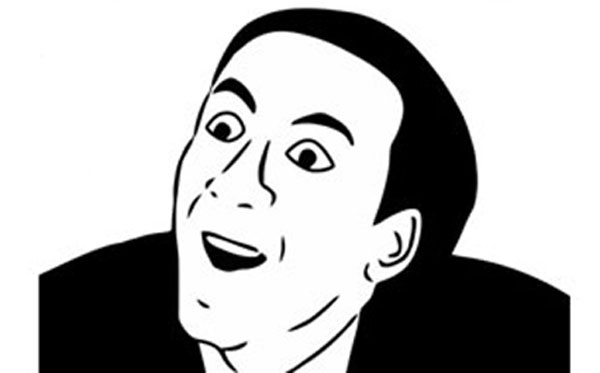
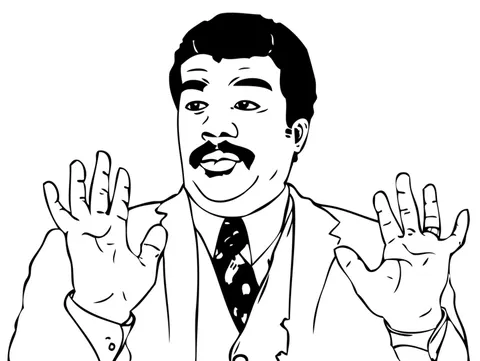
The drawing shows a man's face with wide-open eyes, raised eyebrows, and a slightly open mouth, as if he's about to let out a surprised exclamation. The image is done in a harsh, high-contrast style: a white background, black fills for hair, clothing, and shadows, and minimal gray tones. All the expressiveness is concentrated in the upper part of the face.
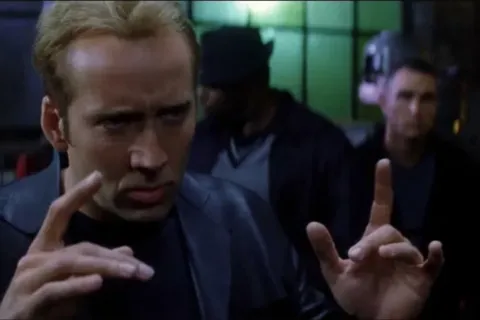
The facial features and hairstyle are what make the drawing recognizable, letting viewers connect it to Nicolas Cage. The scene's basis traces back to a shot from the 1988 film Vampire's Kiss, where Cage plays a literary agent who gradually convinces himself he's turning into a vampire. That character's expression became the model for the drawn face.
how it appeared
The exact date of the drawing's first publication and its author's name are hard to establish from open sources. The strongest link runs through the era of rage comics, simple drawn comics with stock expressions that circulated across forums and imageboards in the late 2000s. Famous faces in that genre quickly turned into convenient reaction templates.
English-language reference resources on internet culture name the drawing's author as a user with the handle LeechHax, tied to a posting on Reddit. However, no date is given in that description, and the attribution rests on the caption attached to the picture, so it can't be considered fully verified. The image's origin can only be called partially established.
The shot itself looks almost documentary, which makes it easy to mistake for an ordinary film still. It's exactly that duality, documentary realism paired with grotesque exaggeration, that helps the image stay in circulation.
The actor himself has repeatedly discussed his internet popularity in interviews, which adds a friendly tone to the image.
how the meme is used
A typical caption appears next to the picture as a response to an obvious statement. If someone writes, "It's cold outside in winter," the drawing gets posted in reply with the caption "Oh really?" The meaning is ironic: the person feigns surprise at something everyone already knows, thereby showing that the statement didn't impress them.
The format is convenient in comments, chats, and arguments, because it replaces an entire sentence with a single look. Users change the text above the drawing while keeping the expression, and the captions get applied to sports, politics, work, and everyday situations. The picture works as a short retort rather than a full statement.
In discussions of film and acting, the picture is often brought up in connection with Cage's filmography. The joke is usually good-natured: viewers aren't mocking the actor but using his recognizable face as a convenient symbol of surprise.
why the meme works
The main comedic mechanism rests on the contrast between the seriousness of the statement and the exaggerated reaction. The face in the picture seems to say, "Is that so?" even though the obviousness of what was said is clear to everyone. This turns the meme into a satirical tool against "captain obvious" types, people who solemnly restate what everyone already knows.
The graphic simplicity matters too. The black-and-white style reduces the face to a few lines, so the picture reads instantly even in a small preview. Cage's expressive acting style, widely known to the public, helps turn the drawing into a symbol of extreme surprise that registers without any caption at all.
Over time the drawing became part of the general stock of internet reactions, understood even by those who don't know its origin story. That's a typical trait of a durable meme: the meaning registers without explanation.