The Brainlet caricature branch
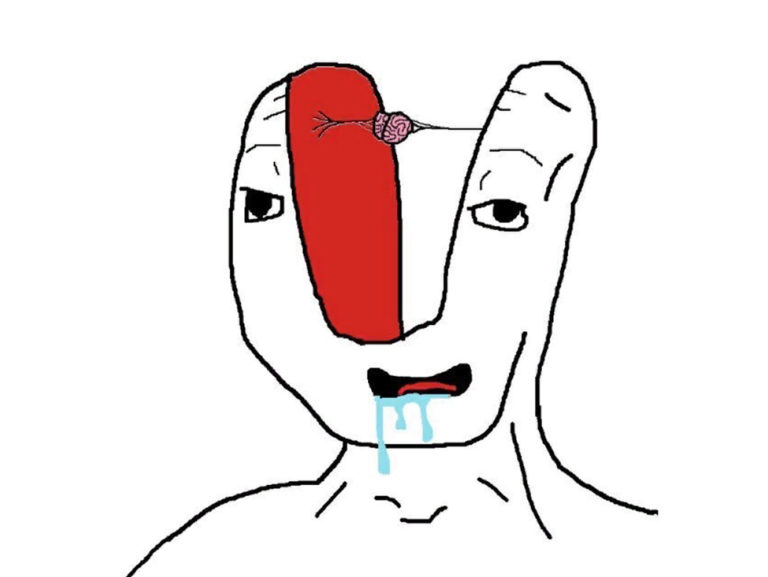
The drawing belongs to the Brainlet family, which gained notable popularity in 2017. These images reworked the face of Wojak, or Feels Guy: the top of the head is missing, crushed, or turns out to be empty. In the micro-brain variant the emptiness is not complete, but the remaining capacity to think is shown as so small that it has to be held up by thin threads. This is a separate visual joke within an already known family.
The author of this specific drawing is unknown. One of the early notable traces refers to a comment on FunnyJunk from May 21, 2018, where it was posted together with other Brainlet caricatures. In July the picture appeared in Russian-language discussions on Kanobu and VKontakte. These traces show the image moving between platforms, but they establish neither the exact day of creation nor the absolute first publication.
Emptiness fills almost the whole head
On a white background there is a person with an elongated head that is open at the top. The large inner surface is colored red; near the upper edge, a small pink brain is held on thin lines. The eyes are half-closed, and blue drops trickle from the open mouth. The black outlines are rough and uneven. There are no captions, names, or second panel in the image.
The proportions of the objects are deliberately broken: the brain is turned into a small knot, and the head into a huge shell around it. The threads hold up the last detail that could explain what is happening in the face. In other variants one line snaps, adding a separate ending. Here it is not shown: the brain keeps hanging, and the comedy focuses on the mismatch that already exists between the large container and the almost absent content.
Thought as the last weak knot
An ordinary portrait does not explain why the person made a mistake. The micro brain offers a parodic explanation directly through the drawing: the task seems to be allotted a minimal share of thinking. Such a conventional caricature suits actions that refute their own goal. The more confident the caption sounds and the more obvious its logical error, the more noticeable the contrast with the tiny object in the empty head.
The threads add a sense of unreliability. The person is not entirely without thought, but the final line of reasoning seems to be holding on with great effort. That is why the image can signal both self-ironic “I almost figured it out” and a situation where the author does not want to analyze a simple problem. Its rough style resembles a quick sketch in a comment: instead of a carefully staged scene, the viewer gets a single exaggerated sign that immediately colors the next line.
Three invented mistakes of purpose
A fictional example: “I set the alarm for 19:00 so I'd wake up by seven in the morning.” The stated goal is sensible, but the chosen action destroys it. Another scenario: “I copied the ‘Backup’ folder into the trash because there's plenty of free space there.” The hero takes a familiar word as sufficient grounds and overlooks the purpose of the storage place, so the empty head becomes an illustration of the missing step in the reasoning.
A third variant: “I wanted to save time on the commute and spent ten minutes choosing between identical routes.” The mistake here is milder: the thought is seemingly present, but the entire resource is spent on a useless comparison. All these situations are invented and belong to the actions of an imaginary author. One such decision is enough for the image: a long story with several causes would turn the caricature into a general judgment of the hero, whereas a precise contradiction lets one see the exact moment when the thought was left hanging by its thin thread.