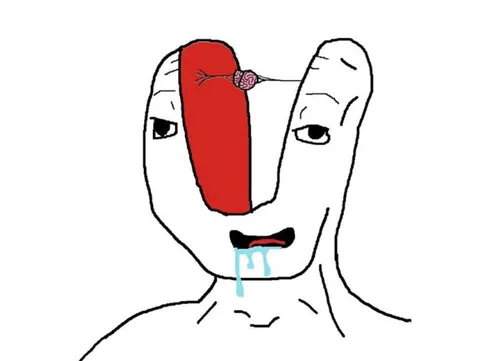
What's depicted
This isn't a photograph but a simple drawing done in the style of popular single-panel 'wojak' characters. The face is elongated, the chin heavy, the hair brown with black streaks, long bangs, round glasses, reddish eyelids under the eyes, and blue tear tracks. The teeth are clenched in a grimace, as if he's about to burst into tears or has been offended beyond measure.
The drawing is crude and deliberately simple: no specific person is depicted, and the facial expression conveys a mix of hurt and confusion.
Where the word comes from
The word 'poridge' comes from the English 'porridge.' According to reference sources, the term caught on thanks to a joke from an imageboard: plain oatmeal disgusts the character, but the exact same dish, called 'poridge' and sold at a restaurant for 290 rubles, delights him. These details rely on a retelling in a single newspaper article, and the exact publication date of the original image couldn't be established; the meme is dated to 2020.
Later, other pairs appeared on the same pattern, such as 'gyoza' instead of pelmeni, and 'hoodie' instead of grandma's sweater.
How the joke reads
The meme doesn't mock an age group or a generation as a whole, but a specific behavior: dismissing something while it's called by its familiar name, and valuing it once it's given a foreign name and served on a nice plate. The drawing of the crying character adds a second layer: the person seems offended that reality doesn't match his taste.
It's worth noting that 'zoomer' here is a joking role, not a diagnosis. It shouldn't be used to generalize about all young people, and the jokes themselves usually rely on self-deprecation.
Examples in the style of the meme
'I won't eat cafeteria porridge, but I'll happily pay 400 rubles for a buckwheat bowl': the caption repeats the oatmeal pattern.
'Won't touch borscht, but a bowl of 'red soup' with a crouton — now that's tasty': a contrast between the familiar name and the foreign one.
'My morning: cereal in a bowl — childhood; granola in a yogurt cup — mindfulness': an example built as a two-item list.
'Sits there crying, waiting for the store to start selling a 'sandwich' instead of a bread-and-butter snack': the drawing captioned as the punchline of the story.
Every example is built on comparing two names for the same thing, and the closer they are in substance, the funnier it gets.
Where it comes in handy
The image suits jokes about marketing, restaurants, and shopping, especially when the price climbs right alongside the English loanword. For a viewer with no context, it helps to add at least one example of the contrast — otherwise the word 'poridge' stays meaningless.
The joke's limits
The word 'poridge' is judgmental, and it's easy to turn it into a jab at anyone who's interested in foreign food, fashion, or music. The meme is funnier when the target is a specific absurdity, like an inflated price for a renamed dish, rather than a person's tastes. A caption works better when it's built around a situation rather than a label for a group of people.
It's also worth remembering how limited the sources are. Details about the original image are known only through a retelling, not from a located original. If you're explaining its origin, it's safer to point to what's visible in the drawing itself: the character, the glasses, the tears, the grimace.