What the picture shows
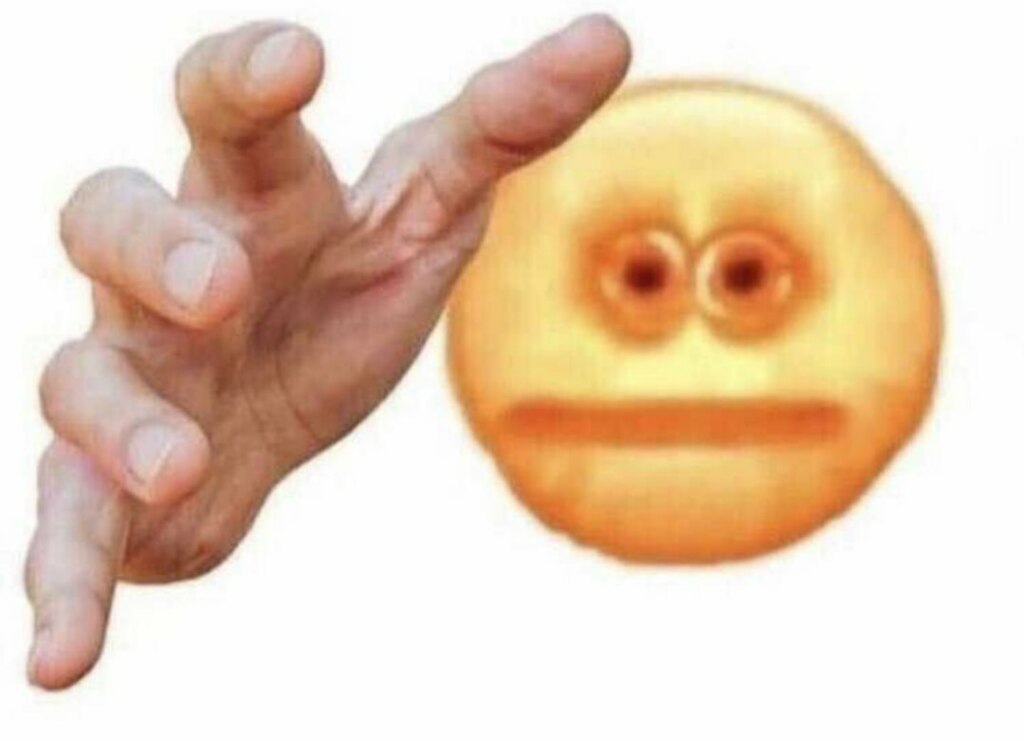
On a white background, on the left, is a large human hand with fingers spread, as if reaching forward. On the right is a big yellow round face drawn like an emoji: wide-open eyes with reddish circles around them, and a straight line instead of a mouth. The edges are blurred and the colors are oversaturated, as after many re-saves of the picture.
The face does not look like a standard smiley from the set: it is deliberately made unpleasant and nervous. The hand looks like a real photograph, and it is precisely the combination of a photo with a cartoonish face that gives the frame its eerie comedy.
Where the picture comes from
The source of this particular edit is not established. A close template from 2019 is known: an emoji with bloody eyes and pressed lips that “reaches” toward the screen with a hand. The early popular versions appeared in August 2019, and a similar idea — a hand reaching out of the screen toward the viewer — had appeared even earlier in clips from a visual novel.
Where the caption “vibe check” came from is not known for certain. Most likely two 2019 memes converged: the expression “vibe check,” which jokingly meant “a mood check,” and the image of a hand invading personal space.
What “Vibe” Means
The word vibe is short for vibration: in English it has been known since the middle of the twentieth century and means the general atmosphere or feeling that a person, place or moment creates. In Russian, “vaib” entered youth speech with the meaning “mood, atmosphere.”
A “vibe check” is a joking test of this mood. People pass it or fail it: “you passed the vibe check” means “you fit in with us,” while “you didn't pass” means “you're not our type.” In memes with a hand and an emoji, this check has taken a visual form: someone reaches out to assess you up close, and it is awkward.
The meme is convenient for posts where the author playfully assesses someone else's mood or their own well-being. The nervous face suggests the check is unlikely to be pleasant, and the hand adds an intrusion into personal space.
Examples for your own caption
“When a friend writes ‘we need to talk’ with no explanation” — the hand emphasizes that the explanation is already close, and you are uneasy.
“My body on Monday morning when asked how it's going” — the nervous face conveys “not great at all.”
“The boss comes into the chat with ‘got a minute?’” — a classic situation where the check foreshadows trouble.
“Me, when the cashier asks whether I need a bag and I forgot mine” — everyday awkwardness reduced to a vibe.
How to apply it
The template works well for short captions about anxious waiting, an awkward check, a sudden intrusion. The more specific the situation, the funnier it is: the hand and the face create the needed tension on their own.
Do not attribute a real threat or violence to the picture: its humor lies in absurdity and awkwardness, not in aggression. Another rule — do not overload the caption: the face already conveys the whole emotion, and extra words only weaken the effect.
It is best to write the caption as a situation where someone is “checking” an awkward moment: an unexpected message, a dubious plan, a question at the most inconvenient hour. Then the hand in the frame plays the role of the situation itself, reaching toward the author.