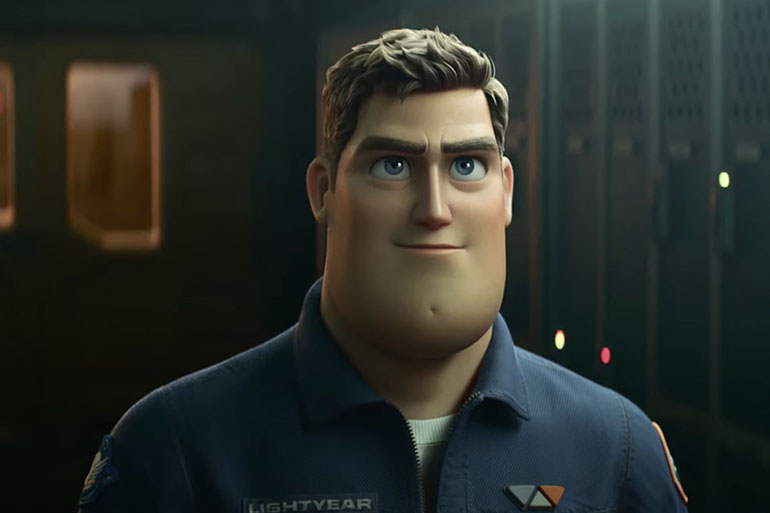
A frame from the story of a space ranger
The image is taken from Pixar’s promotional material for Lightyear, released in 2022. In the teaser the character looks at his gear and prepares for a space mission. The film tells the story of space ranger Buzz, who served as the inspiration for the toy from the Toy Story series; it is a separate story within the familiar franchise. The frame quickly became a reaction to a new form, a new status, or an unexpectedly serious task.
Not every version of the meme shows a scene from the feature-length film: some use the promotional teaser, a trailer, or an edited still. So it is better to describe it as a frame from the Lightyear promo if the specific source is unknown. Buzz is assessing his equipment here rather than commenting on an everyday event; that reading is added by the user’s caption. Do not attribute to the hero words he does not say.
A familiar hero in a new suit
The character’s expression can be read as a mix of surprise and appraisal. The viewer sees a moment of transition: the familiar image gives way to a more high-tech form, and the hero seems to try on a new version of himself. This works well for jokes about a phone update, a new job, a change of style, or a sudden set of responsibilities. The format does not require knowing the film’s plot, although fans will notice the link to the toy’s backstory and the space ranger.
The meme works through recognition: a person remembers what the character used to be and sees him in new gear. If the change is minor, the reaction can be deliberately pompous. If the change matters, the frame conveys pride and readiness. Do not reduce it to mocking appearance or body; the suit and the role are a safer and more precise subject for jokes.
Captions for updates and changes
“Opened the laptop after the update: where are my buttons, and who gave me this new interface?” is an example of a reaction to a familiar tool in changed form. “First day in the new position: the uniform looks the same, the responsibility is already cosmic” uses the contrast between habit and the scale of the role. “When I put on work clothes and suddenly felt like someone who can solder” turns the suit into a symbol of new skill.
A fan version could be: “Toy Buzz watches his cinematic version get its own story.” Such a caption relies directly on the link between the franchise and the character. For everyday humor, this works: “They asked me to just look after a houseplant, and I’m already studying lighting modes.” It is important to say what has changed; without context the frame is just a nice suit.
How to use the frame
Keep the caption clear of the face and the gear, otherwise the reaction is lost. A comparison can be set in two lines: “expected an ordinary day” and “got a new role”. Do not overload the image with a long dialogue. When discussing the cartoon, distinguish Lightyear’s Buzz the ranger from the toy hero in Toy Story if that matters for the meaning.
Pixar frames are protected by copyright; for commercial materials check the permitted use. Do not call a promotional frame an exact frame from the film if the source is not established. The template is especially suitable when a person meets a new version of a familiar object or of themselves: an update, a uniform, a job title, a difficulty level. Then the suit becomes a visual metaphor rather than a random illustration.