The frame that is shown
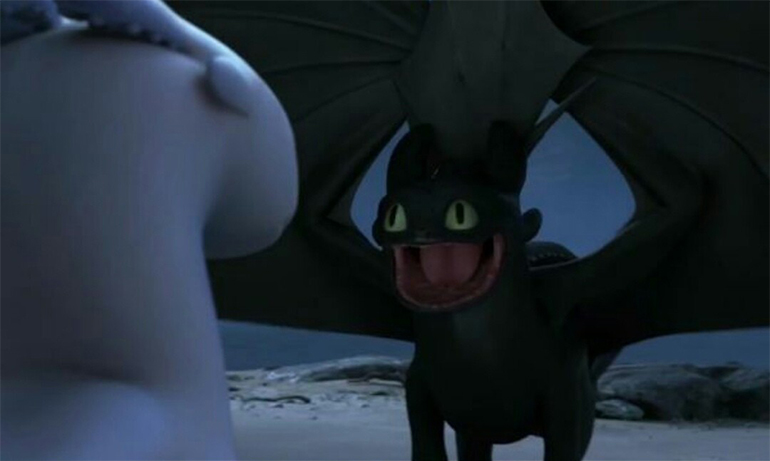
The image is a frame from an animated film. The black dragon Toothless stands facing the viewer, head slightly tilted, mouth wide open, green eyes with narrow pupils looking at whoever is nearby. His wings are spread overhead, and behind him one can see a night sky and a light rocky shore.
On the left foreground a blurred white silhouette is visible, almost entirely cut off by the frame. The picture has no captions or text: meaning is supplied by the viewer, so the frame is easy to read as a scene without a ready-made joke.
The film that gave the image
How to Train Your Dragon: The Hidden World was released in 2019 and concluded the main storyline about the Viking Hiccup and the dragon Toothless. In this installment the hero gains a companion, the white Light Fury, and the frame is taken from a scene where Toothless tries to win her over.
For the viewer the emotion matters: the dragon looks open and happy, while nearby is someone who either doesn't look or responds reservedly. Most captions grow out of that gap.
The dance and its separate life
Later, fan edits in which Toothless dances to upbeat music spread online. Who exactly came up with this pairing, and when it appeared, has not been reliably established, so no specific date or author can be stated.
It is important to distinguish the original scene from the film from the later edits: this picture has no dance and no music; it is simply a still of an open and pleased dragon.
What makes the joke funny
The main device is the pause and the facial expression. The hero in the frame looks open and pleased, and the caption turns his openness into an invitation that is met coldly. The result is a short scene: one opens up, the other stays impassive.
The composition works too. The white dragon occupies the edge of the frame and is barely visible, so the viewer completes his reaction in their own mind. What is left unsaid matters more than the reaction itself.
Caption examples
“I asked what you thought of our plan, and in reply I heard: ‘Well...’” An open question that expected a cheerful answer meets a dry pause.
“Came to the party, danced, and in reply got only tomorrow's to-do list.” The image of an open hero is transferred to an everyday situation: there is initiative, but no response.
“A colleague sent the spreadsheet on Friday at 6:59 PM, and I'm already dancing.” A modest event becomes a reason for delight, and the exaggerated joy over a trifle creates the effect.
All the captions rest on one thing: first an open gesture, then a closed reaction. The laugh arises from the mismatch between expectation and reality.
When the frame fits
The template fits when you need to show joy that was not shared. It works well for short stories about waiting and unexpected replies, especially if the caption makes clear what exactly happened.
The image belongs to cartoon characters, so it is better to write captions about fictional or one's own situations rather than about specific real people.
A good caption names both the one who is delighted and the occasion, and leaves the response unspoken.